Demister Suppliers: What Engineering Data to Include
A demister supplier can return a useful quote only when the RFQ defines the separation duty, the vessel envelope, and the acceptance requirements together. Send only a diameter and a material, and the supplier must assume the rest. Send the right engineering data, and competing offers can be compared on the same basis: mesh construction, support grids, materials of construction, pressure drop, and installation scope. This article covers the information buyers should include for wire mesh pads and vane packs so the price is not a placeholder but a workable technical proposal.
Start with the Process Conditions
The first part of a demister quote request should describe the gas and liquid service accurately. A vague statement such as “air with some mist” does not give the supplier enough to size the pad, select the mesh density, or choose between a wire mesh pad and a vane pack.
The most important inputs are flow rate, operating temperature, pressure, liquid loading, and gas composition. Gas velocity controls vessel diameter, mesh area, and the risk of re-entrainment. Liquid loading separates a light mist duty from a heavily wetted or slugging service. Droplet size, when known, affects whether a fine mesh is justified or whether a vane pack will drain better.
| Required input | What to provide | Why it matters |
|---|---|---|
| Gas flow rate | Normal and maximum actual flow in m3/h or Nm3/h with reference temperature and pressure | Gas velocity controls diameter, mesh area, and re-entrainment risk |
| Operating temperature and pressure | Minimum, normal, and maximum values, including pressure spikes | Gas density changes velocity; temperature sets material limits |
| Liquid loading | Entrained liquid in kg/h or m3/h, with liquid density and viscosity if known | Distinguishes pad duty from vane pack duty and affects drainage |
| Droplet size | Measured or estimated droplet distribution where available | Finer droplets may need denser mesh or a more careful design check |
| Gas chemistry | Water vapor, acid gases, chlorides, solvents, or trace species | Determines alloy or plastic selection and corrosion allowance |
| Solids and fouling | Concentration, particle size, stickiness, and wash availability | Solids can plug mesh and make a vane pack easier to clean |
Define the Vessel and Installation Envelope
A demister is installed inside a specific vessel, so the quote must include the installation boundary. The supplier needs the vessel inside diameter, not a nominal pipe size or an approximate shell outside diameter. For a replacement, a measured installed diameter is more useful than an old drawing that may not reflect the current vessel.
State the vessel orientation, flow direction, and available straight run around the demister location. Include manway size, access restriction, support ring detail, and nozzle arrangement. For large pads, the supplier may need to split the demister into segments for installation. Without that information, the quote cannot confirm whether a one-piece pad or a segmented pad is required.
Also record the pad thickness or vane pack height expected, the number of pad layers, and whether the installation uses a top and bottom support grid. These details affect both the cost and the ability to install the unit without deformation.
Choose a Wire Mesh Pad or Vane Pack
The choice between a wire mesh pad and a vane pack should be decided by liquid load and fouling risk before the supplier is asked for a price.
| Selection factor | Wire mesh pad | Vane pack |
|---|---|---|
| Flow channels | Fine mesh with dense interception | Wide angled channels between plates |
| Liquid loading | Better for low to medium entrained liquid | Better for medium to high liquid loads and slugging |
| Fouling | Small openings can blind with solids or sticky mist | Larger channels allow online spray washing |
| Pressure drop | Normally lower at clean conditions | Slightly higher for equal duty, but stable when wetted |
| Installation | Lighter pad, often round or drawer and wave sections | Heavier frame, blade packs, and spacers |
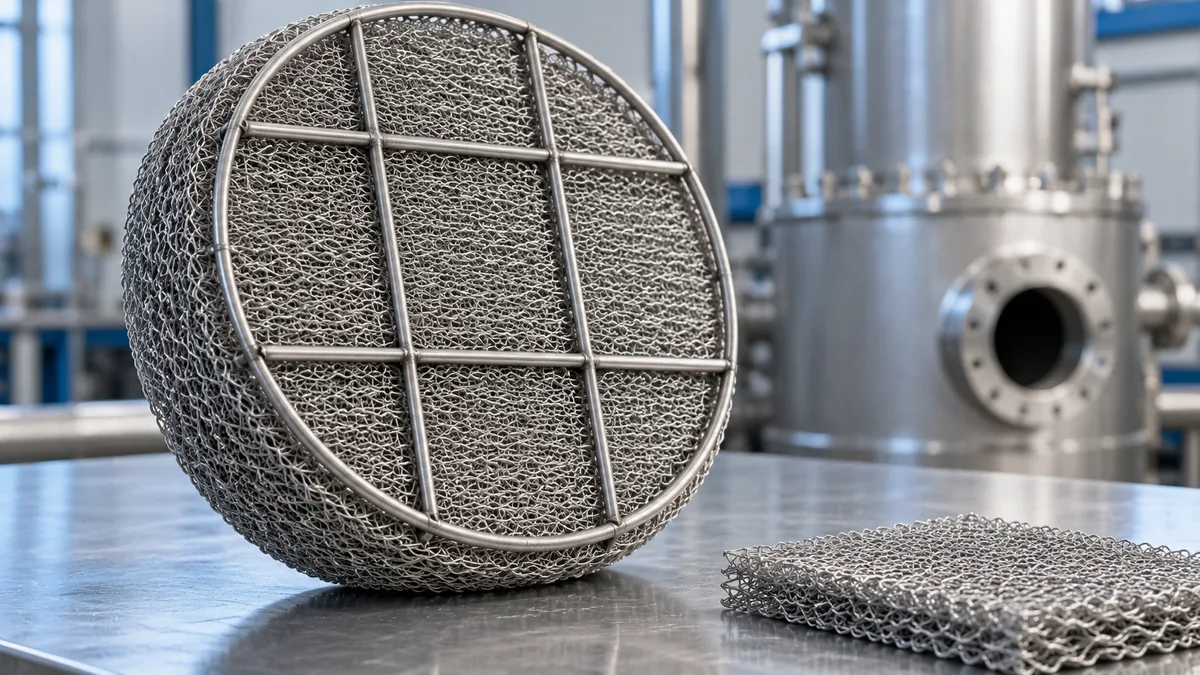
A wire mesh pad uses fine metal or plastic filaments to capture droplets by collision and coalescence. It works well when the mist load is moderate and the gas is clean. The pad must drain downward freely. If the liquid load is too high, liquid can accumulate in the mesh, increase pressure drop, and carry over as larger drops.
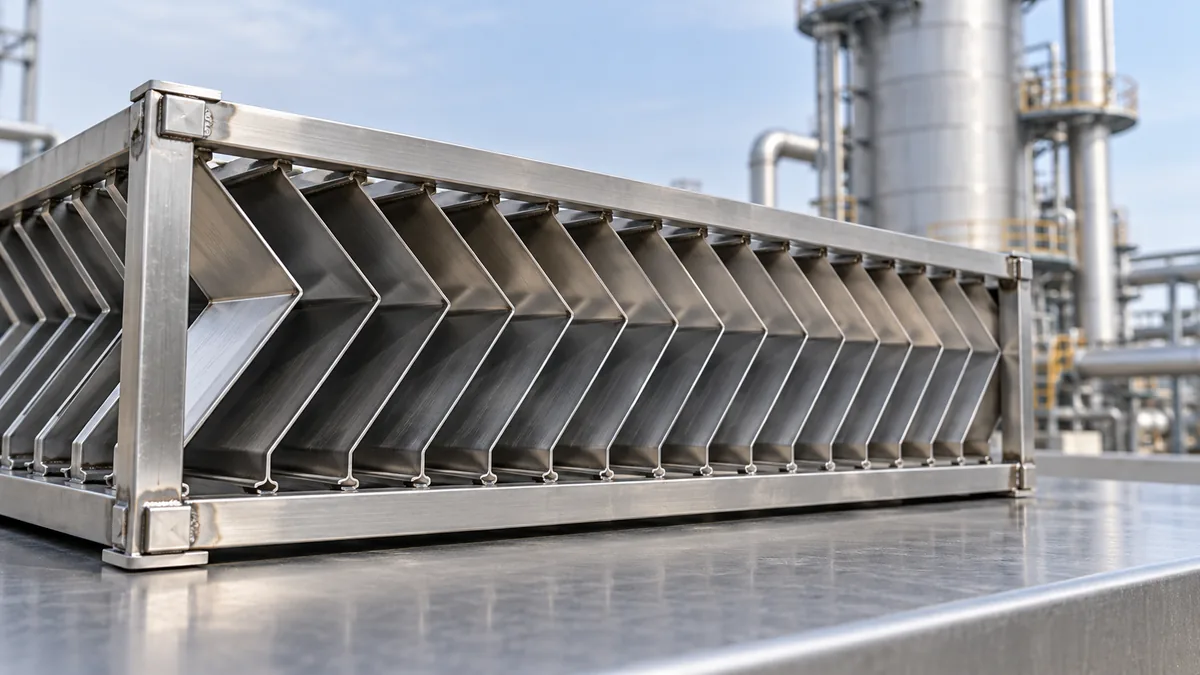
A vane pack uses bent plate channels that force the gas to change direction repeatedly. Droplets hit the vane surfaces, coalesce, and drain. The channels are larger than mesh openings, so vane packs tolerate higher liquid loads, viscous liquids, and solids better. They also allow online spray washing in services that tend to foul.
Specify Materials for the Real Gas Composition
A quote should state material requirements for every wetted part, not only the mesh or vane body. The gas composition, chloride content, pH, temperature cycles, and upset conditions decide whether an alloy or engineering plastic is appropriate.
Shine Technology’s demister range includes stainless steel grades such as 304, 304L, 321, 316Ti, 316L, 317L, 904L, and 310S. Titanium alloys, nickel alloys, super duplex 2507, and engineering plastics including PP, PE, PVC, PTFE, FEP, and PVDF are available where corrosion or temperature demands them.
For vane packs, material selection follows the service temperature and chemistry. Stainless steel 304 or 316L can be considered for weak acid or alkali and high temperature service up to 450°C. Polypropylene suits low temperature dilute acid scrubbers up to 90°C. PVDF suits chlorine containing gas and pickling service up to 140°C. PTFE suits strong acids, alkalis, and solvents up to 260°C.
The quote should also state the wire diameter, mesh density, pad thickness, and any plastic or metal support grid material. A 316L pad installed with carbon steel tie wire or grids can still fail at the hardware. Ask the supplier to confirm that the mesh, grid, fasteners, and spacers are all compatible with the same gas stream.
Put Support Grids and Hardware in the Quote
Wire mesh demisters are not mesh alone. A complete quote should separate the pad, top and bottom support grids, grid rings or bars, tie wire, spacers, and fasteners. If these are not listed, suppliers are pricing different hardware. A lower quote may simply omit the support grid or use thinner material.
For vane packs, confirm frame size, blade spacing, vane orientation, spacers, bolting, and any cleaning lance connections or drainage details. Ask whether the frame will be supplied in the same material as the vanes. If the vane pack is segmented for installation, the quote should state the number of segments and the required assembly hardware.
Support grids prevent sagging, hold the pad in position, and resist gas load. Their open area and thickness affect pressure drop and mechanical life. A quote that does not describe the grid design is not ready for comparison.
Request Drawings and a Scoped Price
A useful demister quotation includes more than a unit price. Request a general arrangement drawing, a bill of materials, and the key dimensional and material data. The supplier should state the pad outer diameter, thickness, mesh density, wire diameter, material grade, grid arrangement, and segment count. For a vane pack, the drawing should show blade spacing, frame dimensions, orientation, and support details.
Ask for acceptance criteria before shipment. These may include dimensional inspection, material certificates, positive material identification for alloy parts, surface condition, and packaging that prevents compression or deformation. For replacement projects, state the existing drawing number or measured diameter. If the supplier must quote without field verification, mark the offer as budgetary and require verification before final order.
A supplier with both wire mesh pad and vane pack capability can check whether the requested pad density, vane spacing, or support grid arrangement is workable before quoting. The same drawing and material data should then be carried into the order confirmation so the received product matches the reviewed design.
Send Your Demister Data for a Scoped Quote
Shine Technology supplies wire mesh demister pads and vane packs with material selection, support grids, and replacement checks. Send the process conditions, vessel drawing or measured dimensions, material targets, and acceptance documents covered in this article. A complete RFQ makes it possible to compare the mesh, grids, hardware, packaging, and delivery scope line by line. Contact the Shine Technology technical team for a quotation.
Demister Quote FAQs
What is the difference between a wire mesh demister pad and a vane pack?
A wire mesh pad captures fine droplets in dense metal or plastic mesh and works well at low to medium liquid loading. A vane pack uses wider angled channels and handles higher liquid loads, solids, and viscous mist more easily. Vane packs are normally heavier and may have slightly higher pressure drop, but they resist fouling and can be washed online.
Can a supplier quote from a vessel diameter alone?
A vessel diameter alone is not enough. The supplier also needs gas flow, temperature, pressure, liquid loading, gas chemistry, and the installation arrangement. Without these, the quote must rely on assumptions. A supplier can give a budgetary number, but a final quotation requires the full process and vessel data.
What material information matters most in a demister quote?
The gas composition and operating temperature matter most. Chlorides, acid gases, solvents, and temperature cycles determine whether stainless steel, a higher alloy, or a plastic such as PTFE or PVDF is suitable. The quote should also identify the support grid and fastener material because corrosion at the hardware can fail an otherwise compatible pad or vane pack.
What acceptance checks should be included in a demister order?
Request dimensional inspection, material certificates, positive material identification for alloy parts, and packaging that prevents compression. For mesh pads, check the outer diameter, thickness, mesh density, and segment count. For vane packs, check blade spacing, frame dimensions, and orientation. The same drawing and material data should be repeated in the order confirmation.