Spare Filter Plate Storage: 6 Mistakes That Cause Damage
Filter plate storage looks like a waiting room rather than a process, which is why damage happens there. A spare plate can be out of tolerance long before it sees slurry: a sealing ridge flattened under a stack, a drainage channel packed with dried solids, a cast iron face pitted by condensation, a rubber membrane that took a set while compressed. None of this is visible in a walk-through of the store. It appears on the first filtration cycle as rim leakage, a longer cycle, wet cake at one corner or a crack at the lifting ear. This article covers the six handling and storage mistakes behind those symptoms, and the checks that catch them before a plate goes into the press.
Why a Spare Plate Can Fail on Its First Cycle
A filter plate is a molded part with several working surfaces, and storage can change any of them. The sealing rim is the narrow band where two plates meet under clamping pressure. The feed port and its boss carry the full slurry flow into the chamber. The filtrate outlets and the drainage surface behind the cloth carry liquid out. On a membrane plate, the flexible face and its bonded edge take the squeeze pressure.
Storage damage rarely removes material in a way you can see. It changes shape, surface condition or clearance. A thermoplastic rim that sat under a stack through two warm seasons creeps and no longer meets its partner flat. A drainage groove that dried with solids in it reduces open area on one plate only, so that chamber drains unevenly. A cast iron face that collected condensation rusts, and the rust both pits the sealing band and releases particles into the filtrate.
The symptoms then appear at the press rather than in the store: leakage at pressure, a cycle that runs longer than it used to, cake that stays wet in one corner, a crack starting at the lifting ear. A plate in this condition has no service history to explain the fault, so the store is the first place to test, not the last.
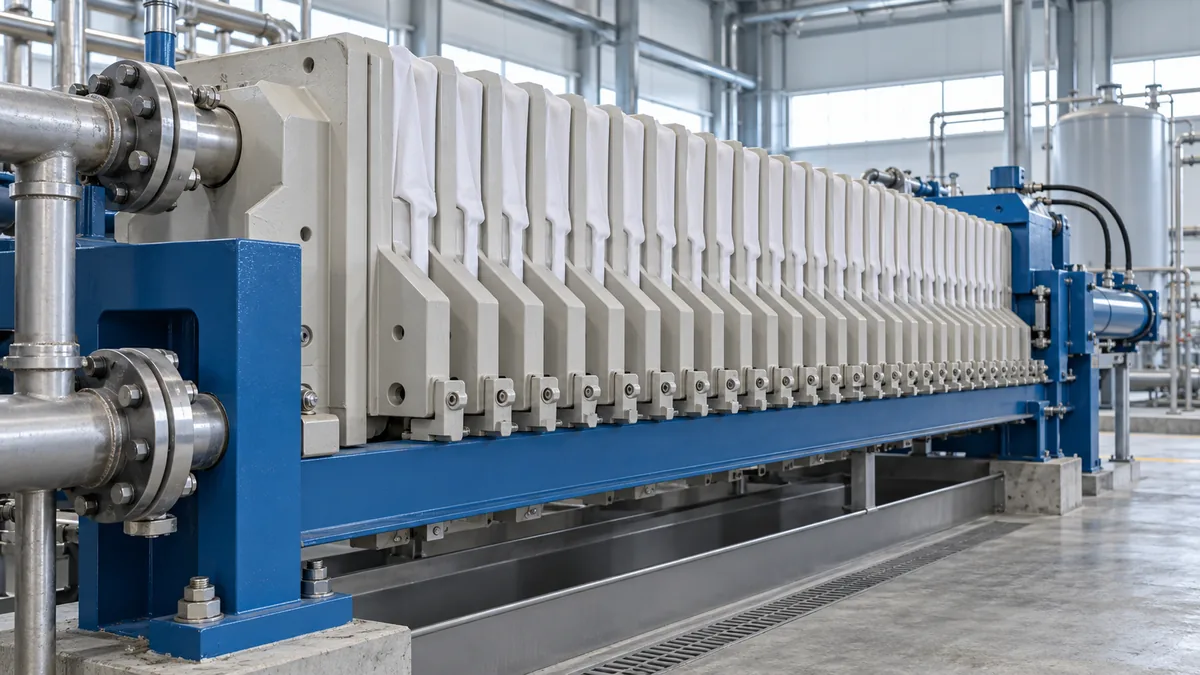
Where Plates Are Stored Decides Whether They Stay Within Material Limits
The first mistake is treating the store as neutral space. Temperature, light, vapours and humidity all act on a plate while nothing appears to be happening.
Temperature alone rarely damages a plate. Temperature with load does, because thermoplastics creep: a plate carrying weight at elevated temperature deforms slowly and does not spring back when the load is removed. A store that reaches 50 °C under a metal roof, or a corner beside a steam line or a dryer, can start that process in a stacked plate even while the plate is nominally inside its rated working temperature. Working limits describe service in the press, not a target for the store.
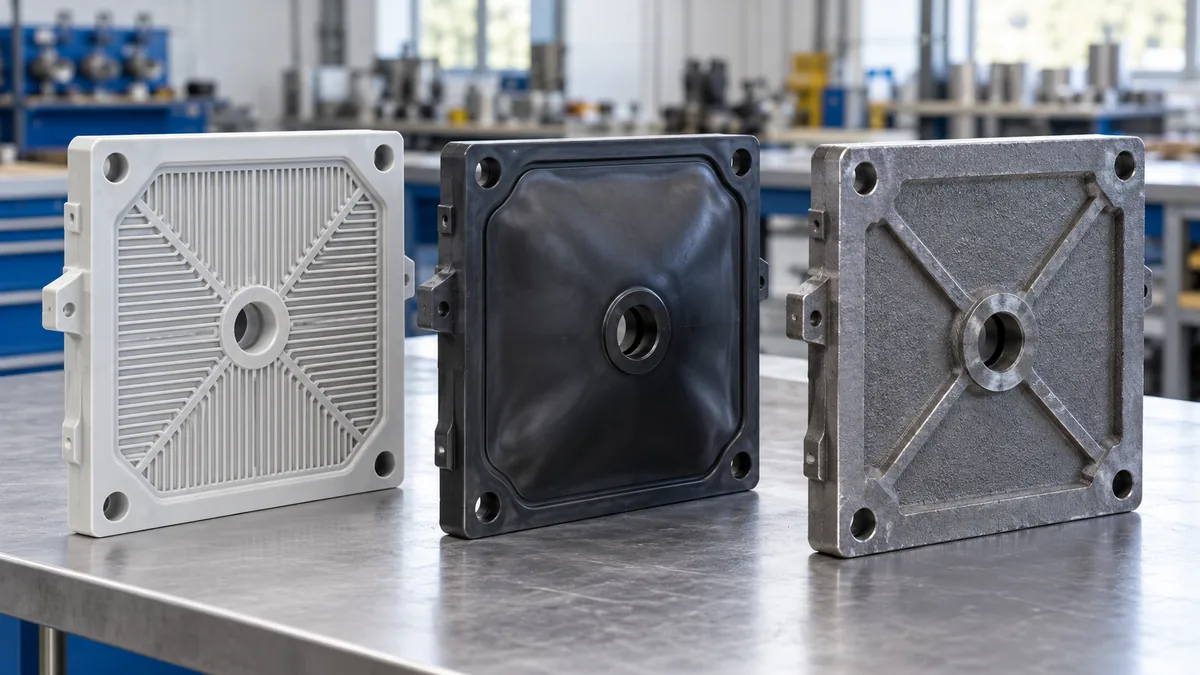
| Plate material | Continuous and transient temperature | pH range | Main storage sensitivities |
|---|---|---|---|
| Polypropylene (PP) | ≤85 °C continuous, ≤90 °C transient | 1 to 13 | Creep under load in a warm store, UV embrittlement, solvent stress cracking |
| Polyethylene (HDPE) | ≤60 °C continuous, ≤70 °C transient | 1 to 14 | Lowest heat tolerance of the four types, UV, load creep at moderate temperature |
| Cast iron | ≤150 °C continuous, ≤160 °C transient | Neutral and weak alkaline | Condensation and rust on sealing faces, chipped edges from impact |
| Rubber membrane, natural or EPDM | ≤75 °C continuous, ≤80 °C transient | 2 to 12 | Compression set if stored squeezed, ozone and UV aging, oil and grease |
Sunlight is the second exposure. PP and HDPE surfaces chalk and embrittle under ultraviolet light, and the edges and port bosses crack first because they present the most surface. A plate that has stood where afternoon sun reaches the stack for a season is not the same component as one kept in a dark rack, even though both carry the same marking.
Chemical vapours matter more than most stores assume. A shared area holding solvent drums, acid containers, welding sets or running motors exposes plates to solvent vapour, acid drip, welding fume and ozone. Rubber membranes are the most exposed, since ozone attacks natural rubber and EPDM and produces fine surface cracks that open further under squeeze pressure. Solvents and surfactants reaching a loaded PP or HDPE plate can accelerate stress cracking at molded edges and port bosses, which is why a plate store should not double as a chemical store.
Humidity and standing water affect materials differently. Cast iron needs the driest position in the building: condensation and a rust film on the sealing band are not cosmetic once the surface pits, and pitting creates a path that clamping pressure cannot close. Keep cast iron off the floor, with the sealing band protected and inspected before use. Thermoplastic plates tolerate damp air but not standing water in ports and channels, and no plate type benefits from grit, dust and traffic passing through its storage area.
The practical arrangement is a dedicated rack, out of direct sun, away from heat sources and solvent storage, off the floor, with a simple summer temperature record kept where store staff can see it.
Stacking and Lifting Mistakes That Distort or Crack Plates
Flat stacking and stack height
The second mistake is flat, face-to-face stacking. In that arrangement the sealing ridge of one plate rests on the flat face of the next, and the weight of the stack passes through ridges, port bosses and lifting ears. A ridge carrying load in a warm store creeps; a port boss carrying load can develop a hairline crack that only opens at clamping pressure. Two sealing ridges pressed together for months can also deform each other, which is why a separator or a single layer is safer than direct face contact.
Single layer storage with the sealing face up on a clean, resilient mat avoids the load path entirely. Where floor space forces stacking, use a frame or pallet that carries the weight on the plate body or edge rather than on the sealing ridge, and set a stack height the plate drawing supports. That height belongs to the supplier’s drawing and the plate size, not to how much floor space happens to be free.
Standing plates on edge
The third mistake is leaving a plate leaning against a wall or against another plate. A plate on edge has a narrow base and a high centre of gravity, so it tips, and a tipped plate often chips a corner or cracks at the lifting ear. A crack at the ear then propagates under clamping pressure, which is why the failure appears weeks later and away from the store. Use a rack with slots, or chocks that restrain the plate at the bottom and the top, so it stands at a stable angle and cannot be knocked over by a passing pallet truck.
Lifting points and slings
Lifting a plate by the feed port eye, a filtrate outlet or a handle is a common shortcut and a common cause of damage. Those features are made for alignment and handling control, not for carrying the whole plate weight. A sling passed through a port puts a point load on the boss. Forklift tines pushed under a plate face scratch the sealing band and can crack the plate at the port. Carry a plate vertically with two people or with a device attached at the intended points, and do not drag plates across a floor: grit picked up by the sealing face ends up as a leak path, and the same grit abrades a new cloth during installation.
Wet Plates, Dried Residue and Cloth Left Fitted
The fourth mistake is putting a plate into the store in the condition it left the press. A plate removed from service carries slurry in its ports, in the drainage channels and around the sealing band, and that film dries into a hard deposit.
Drainage channels and filtrate outlets are small by design, so a thin film of dried solids removes a meaningful share of the open area on that plate. The next cycle then drains unevenly: cake moisture rises, the cycle lengthens, and one area of cake stays wet. This is easily misread as cloth blinding, and the cloth gets changed while the real cause sits in the plate. Clean the plate before it goes into storage, clear every channel and outlet, and dry it, so the plate enters the store ready to install.
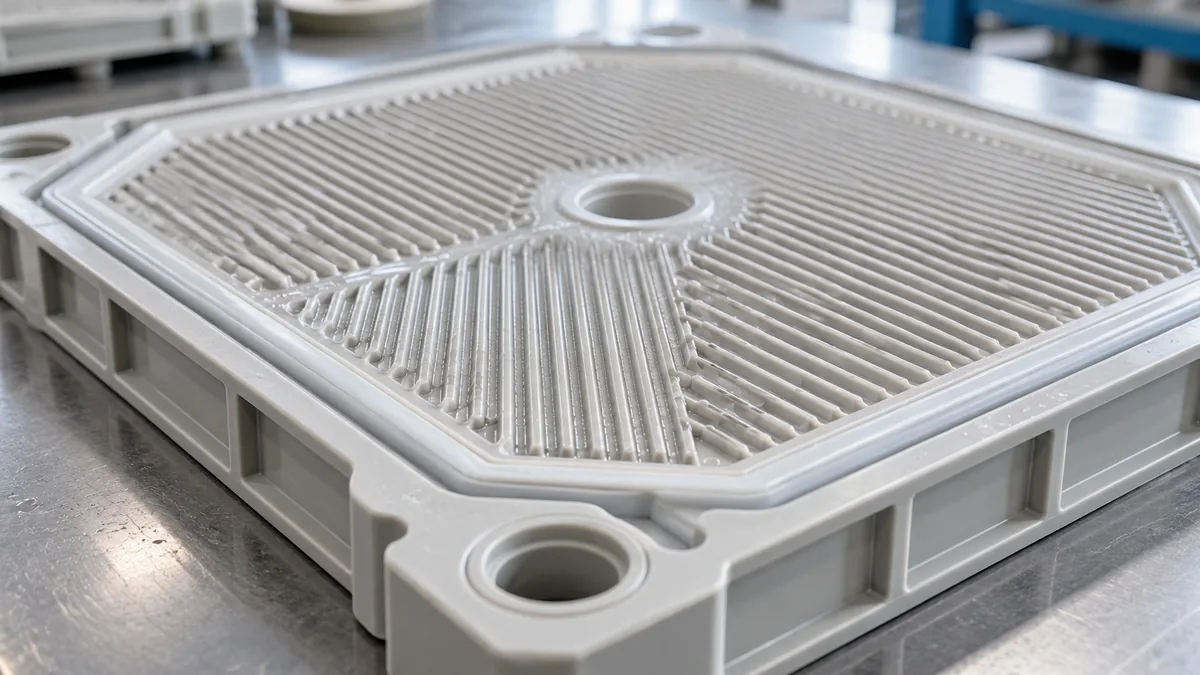
Cast iron needs particular attention after wet service. Residual slurry holds moisture against the surface, and rust starts in the same low points where slurry collected. A rubber membrane plate stored with the membrane compressed takes a compression set, so the squeeze stage applies pressure unevenly afterwards. Store membrane plates without load on the flexible face.
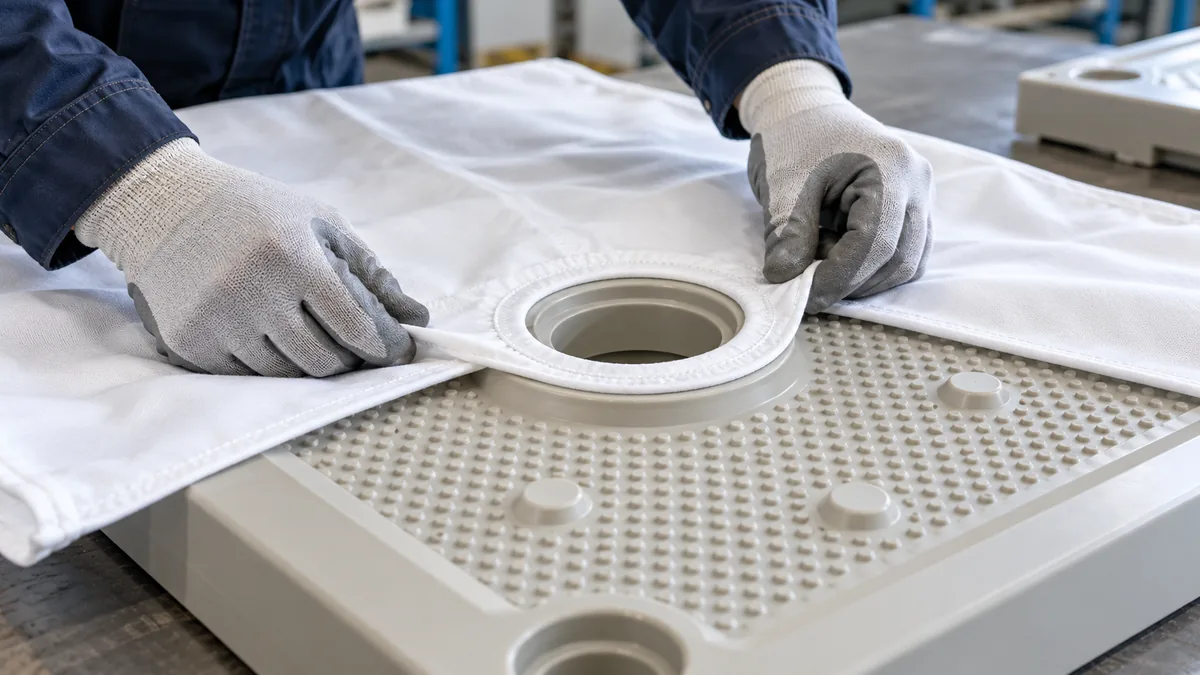
A cloth left fitted on a stored plate is the most avoidable part of this mistake. The cloth holds moisture against the sealing band and the drainage surface, it creases where the plate stands or where the next plate presses on it, and a crease becomes both a leak path and a wear line. In food, pharmaceutical and other hygiene-sensitive duties, a damp cloth is also a growth site. Remove the cloth, clean and dry it, store it rolled or flat and labelled with its plate, and fit the working cloth at installation. Keep any used cloth retained for reference separate, dry and identified.
Mixed Plate Identities in the Spare Parts Store
The fifth mistake is letting a spare parts store become a pile of similar-looking plates. Plates of the same nominal size are not interchangeable across orders. Chamber depth, plate thickness, port layout, material grade and membrane configuration can all differ while the outline looks identical, and once the plates are stacked together the differences disappear.
What follows is a set of problems that look like process faults. A chamber plate mixed into a membrane stack cannot be squeezed. Two plates with different chamber depths produce uneven chamber volume, so fill, cake formation and clamping load all become uneven across the stack. A plate from a different drawing with a shifted port layout restricts feed at that position and erodes around the port. A material substitution made without a compatibility review, for example an HDPE plate used where PP was specified or the reverse, may be correct for one slurry and wrong for the next, and the resulting stress cracking appears months later. Each of these is a procurement error that presents as a filtration fault.
Tagging solves it cheaply. Mark each plate at receipt with order number, drawing revision, material, size and chamber depth. Keep each batch with its documentation, issue the oldest first, and hold plates awaiting assessment in a separate quarantine area so they cannot be picked by mistake. Identity is also what makes a later technical question answerable: a supplier can check a claim against a drawing revision, not against a description of what the plate looked like.
The Receiving and Pre-Installation Check That Catches Storage Damage
The sixth mistake is installing straight from the store without a record. A plate that has been in storage for a year is an unknown quantity unless somebody checked it on arrival and again before installation.
At receipt
Inspect plates before they enter the rack, not after. The inspection is short, and the record is what protects a claim later.
| Check | How to do it | What to record | Escalate when |
|---|---|---|---|
| Identity and marking | Compare the tag, packing list and drawing revision | Order number, revision, material, size, chamber depth | Tag missing or revision does not match the order |
| Size and thickness | Measure with the instrument named in the agreed specification, at the points shown on the drawing | Each measured value and the instrument used | Any value outside the drawing limit |
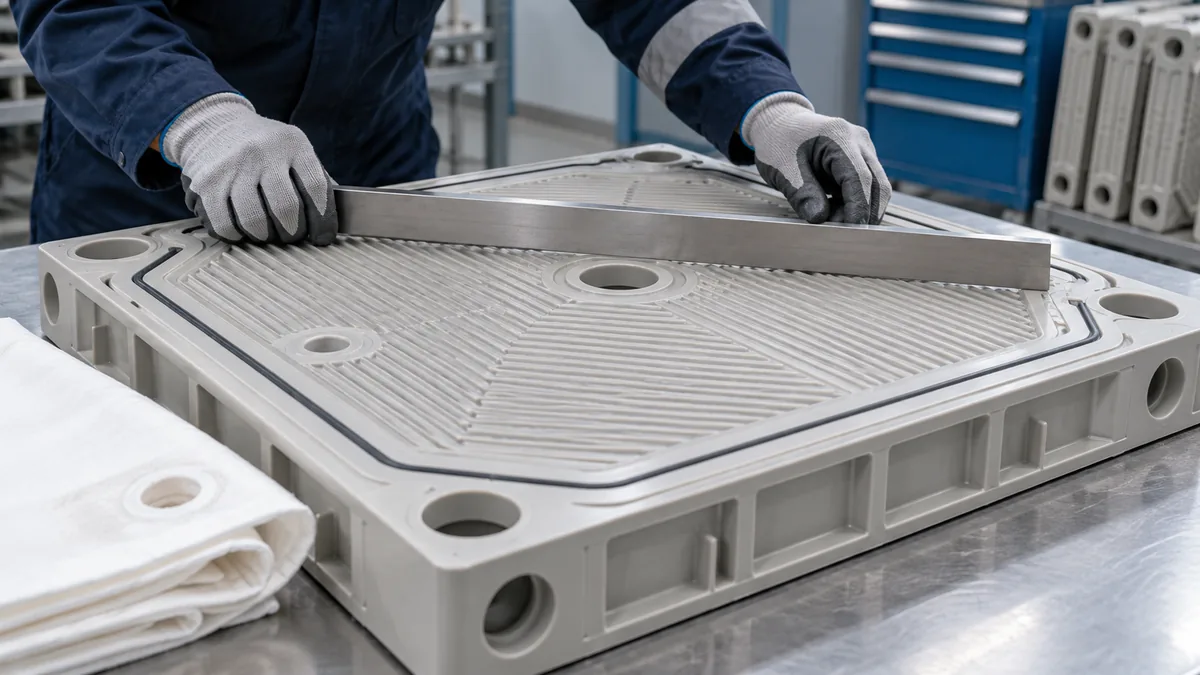
| Flatness and edges | Place the plate on a flat reference surface and look along the rim; inspect corners and lifting ears | Photograph, plus a note of any rock or chip | Visible rock, crack, or a chip at an ear |
| Sealing band | Clean the band and inspect in raking light for rust, grooves, chips and embedded grit | Photo and position of the defect | A groove or rust pitting on the sealing path |
| Ports and drainage | Look through the feed port and outlets, and confirm every channel is clear and dry | Confirmation of clear, dry condition | Blocked or deformed port, cracked boss |
| Membrane or rubber face | Check for compression set, a lifted bonded edge, ozone cracks and oil contamination | Photo and description | Lifted edge, crack, or deformation that does not recover |
Before the plate goes into the press
- Required. Confirm the tag matches the drawing revision, material, size and chamber depth required at that position in the stack.
- Required. Wipe the sealing band clean and examine it under good light for rust, grooves, chips and embedded grit.
- Required. Place the plate on a flat reference surface and check that it sits evenly and does not rock.
- Required. Confirm the feed port, filtrate outlets and drainage channels are clear and dry.
- Optional. Compare a stored plate against a plate from the same batch that has run without problems, when identity is uncertain.
- Optional. Photograph the sealing face and edges before installation, so a first-cycle leak has a baseline for comparison.
Do not install a plate with a crack anywhere, a chip or groove on the sealing band, a membrane with a lifted bonded edge, a plate that rocks on a reference surface, or an identity that cannot be confirmed. The acceptance basis is the approved drawing and the agreed specification; this article sets no tolerances, and a visual pass is not a substitute for a dimensional check on a plate that has been stored loaded or in a hot location.
Protect the Next Set of Spares Before the Shutdown
Spare plates are usually bought well ahead of the shutdown that needs them, which leaves months in which a store can undo a good specification. If you are holding plates for a planned replacement, send Shine Technology the plate size and chamber depth, the material grade, the drawing revision, the membrane type if the stack uses one, how long the plates have been in store, the storage conditions, and photographs of the sealing band and edges. Our technical team can compare that against the drawing and tell you whether a plate should be installed, kept in quarantine, or assessed before it goes into the press. Include the storage location and dates, because that record is what turns a first-cycle leak into an answerable question. Start at shinefiltration.com with the drawing revision in the subject line.
FAQ
How long can spare filter plates be stored before installation?
There is no fixed storage life. A plate does not age on a calendar, but its materials change with load, temperature and exposure. Thermoplastics creep under sustained load, rubber membranes take a compression set and age under ozone and ultraviolet light, and cast iron rusts in humid air. A plate stored in a single layer, dry, out of sunlight and away from heat can remain serviceable for years. The pre-installation check decides whether it goes into the press, not the number of months on the label.
Should the filter cloth stay fitted on plates in storage?
Usually not. A fitted cloth holds moisture against the sealing band and drainage surface, creases where the plate stands or where another plate rests on it, and in hygiene-sensitive duties becomes a growth site. Remove the cloth, clean and dry it, store it rolled or flat and labelled with its plate, then fit the working cloth at installation. If a cloth is left on to keep dust off a plate in a clean, dry store, keep it uncompressed and confirm the plate face is dry first.
Can PP or HDPE filter plates be stored outdoors under a tarpaulin?
It is a poor arrangement. A tarpaulin raises the daytime temperature inside a stack, traps condensation and does nothing for ultraviolet exposure at the edges. HDPE has the lowest continuous limit of the common plate materials at 60 °C, and a warm stack under load creeps. If no indoor space is available, stand plates on edge under a rigid, ventilated cover, off the ground and out of direct sun, then inspect them fully before installation instead of assuming they are unchanged.
Which storage problems are hardest to see before installation?
Load-induced creep of the sealing rim, dried solids in drainage channels and early ozone cracking on a rubber membrane are the three that leave a plate looking intact. Each changes performance rather than appearance: the rim leaks at pressure, the chamber drains unevenly, the squeeze becomes uneven. A dimensional check, a look along the sealing band in raking light and a clear view through the ports find them. Appearance alone does not confirm that a stored plate is fit to install.
Can a plate that was stored wet be cleaned, dried and used?
It depends on the material and on what the moisture did. On PP, HDPE or rust-free cast iron, clean the plate, clear and dry every channel and outlet, then re-inspect the sealing band and ports; if they are sound, the plate can be used. Cast iron with rust pitting on the sealing band, or a membrane plate stored compressed, needs assessment before installation. Drying reverses neither creep nor compression set, so a plate that was stored loaded in a warm store still needs the dimensional check.