How to Compare Filtration Supplier Quotes Line by Line
Two filtration supplier quotes can differ by a wide margin and still describe different products. The gap is not a discount until each line is converted to the same scope, the same measured quantity and the same delivery basis. Quotes for filter cloth, filter plates, cartridges and demister internals arrive with different unit conventions, different material grade names and different views of what the price includes, so comparing totals first tends to reward the narrower offer. The method below reads the claim behind each figure, normalizes the measurement basis, then compares the cost that actually repeats.
What Makes Two Filtration Quotes Hard to Compare
Three variables move independently between suppliers: what the price includes, which quantity is being measured, and how the commercial terms are set. A quote can be cheaper because it leaves out gaskets, because its filtration rating means something different, or because it is priced at a different quantity break. Each of these explains a price difference without saying anything about the material in the box.
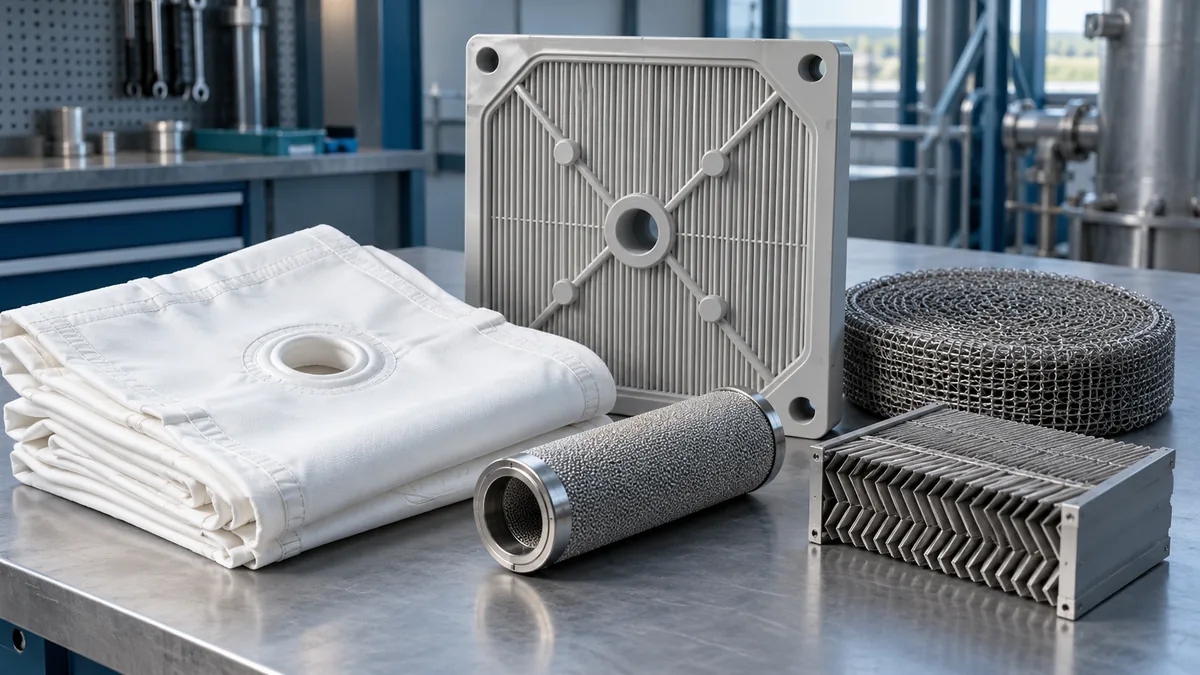
One mechanism makes the problem visible. Cloth for a single press may be quoted per cut panel, per set of panels, or per square metre of roll goods. A cut panel already contains the cutting waste and the sewn or welded edge, so its per-piece price will look higher than a per-square-metre figure that excludes both. The same pattern appears in plates quoted without handles or support pieces, cartridges quoted without seals, and demister pads quoted without support grids. None of these are dishonest offers. They are offers at different boundaries, and a boundary difference is not a price difference.
The useful output of the exercise is therefore not a ranking of totals. It is a per-item record in which scope, unit basis and terms are identical, so the difference that remains can be attributed to material, construction or manufacturing cost.
Read Each Quote Line as a Claim, Not a Specification
Every figure on a quote is a declaration made under conditions the supplier chose. Asking which conditions is not a sign of distrust; it is the only way to know whether two numbers describe the same physical thing. A filtration rating of 5 µm on a needle felt describes depth capture through a fiber structure, while the same 5 µm on a woven monofilament describes an aperture between yarns. The number matches, the meaning does not.
| Claim on the quote | What it can support | What it must not be read as |
|---|---|---|
| Polypropylene cloth, 8 to 50 µm | The polymer family and the supplier’s stated filtration grade for that line | That the grade was measured by a named method, or that one weaver’s band matches another’s |
| Continuous temperature up to 120 °C | The material’s listed limit under the supplier’s reference conditions | That the cloth holds that temperature in your slurry at your cycle pressure and wash routine |
| 550 g/m², 1.2 mm | Mass per area and thickness of the sampled cloth | Capture performance, permeability or service life |
| Air permeability 8 to 14 m³/(m²·min) | A flow range under the conditions the supplier tested | Equivalent flow in your press, where the test conditions are not your process |
| Certificate of conformity | A batch declared against the supplier’s own specification | Independent verification of grade, origin or performance |
| Unit price per piece | Price at the stated quantity, currency and delivery term | Cost per filtration cycle or per tonne of dry solids |
Most quotes state exactly what the supplier can support, and that is a reasonable place to start. The difficulty is that a declaration cannot do the work of a test report, and a missing method is an open item to close before award rather than evidence that two products are equivalent. Read the third column as a boundary: it does not claim the supplier is wrong, it records what the comparison still needs.
Convert Every Quote to the Same Measured Quantity
Normalization happens at three levels: the unit (piece, square metre, element, set), the descriptor (rating, weight, permeability, thickness), and the consumption period (one purchase or twenty cycles). Fixing only one of the three usually leaves the comparison as misleading as before.
Filtration rating is not one measurement
Rating systems differ by construction. Woven cloth is often described by aperture in micrometres, needled felt by a filtration precision figure tied to a test dust or particle count, and cartridges by a rating that may be nominal or absolute. Air permeability, quoted in m³/(m²·min) or in mm/s, is a flow measurement under stated conditions, not a capture measurement. Weight in g/m² describes mass per area and says nothing about pore structure. When two quotes give one number each and the numbers come from different systems, ask for a second descriptor that can be compared directly, such as air permeability alongside the rating, or a sample for a side-by-side check.
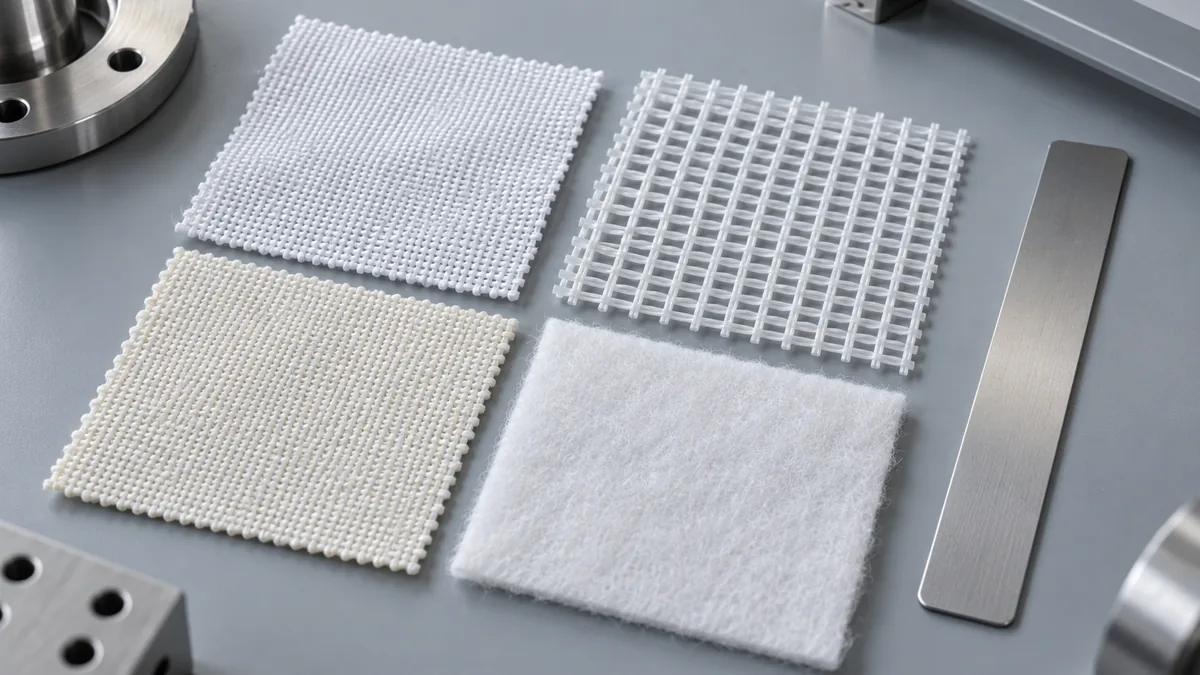
Tighter is not automatically better. A fabric selected tighter than the particle distribution requires can blind early, while an overly open construction can delay initial filtrate clarity. That tradeoff is the reason the comparison needs the method behind the number, not only the number.
Price per piece, per square metre, per cycle
Convert every line to the basis you actually consume. Cloth is consumed per press set and replaced after a number of cycles, plates are replaced individually and sometimes as a stack, cartridges are replaced as elements per housing, and demister internals are replaced as a set of segments with grids and fasteners.

Once the consumption unit is fixed, the repeating cost becomes calculable.
Cost per filtration cycle = (media cost + fitting labour + lost production during the change) ÷ cycles achieved before replacement
Cost per tonne of dry solids = media cost ÷ (dry tonnes per cycle × cycles achieved)
Both formulas need a defined end point for the cycle count. Set it before any trial: filtrate clarity below the plant requirement, cycle time beyond the baseline established with new media, or cake moisture above the downstream limit. Without a stated end point, a cycle count is an opinion. For a housing that holds many elements, the labour and lost-production term can outweigh the difference between two element prices, which is why a cheaper cartridge does not automatically reduce the cost that repeats.
| Line item | What the quote usually states | Field to request instead | Why the substitution changes the comparison |
|---|---|---|---|
| Filter press cloth | Price per piece for a named model such as 729 or 750B | Cut dimensions, panels per press, weave and areal weight, edge treatment, filtration rating with its method | Model names carry different constructions between weavers, so a model match is not a material match |
| Filter plate | Size and a polymer name with one pressure figure | Size, chamber or membrane type, chamber depth, pressure class, port layout, handles and supports | Pressure class has to match the whole press rather than the feed pressure, and a plate quoted without handles is a different scope |
| Filter cartridge | Diameter, length and a filtration rating | Medium and grade, outer diameter and length from the standard set, end fitting, seal material, cleaning method | A similar-looking element with a different end fitting or seal will not fit the housing |
| Demister pad | Pad dimensions and a material name | Mesh type and density, wire or plastic grade, thickness, segment layout, support grid and fasteners, design gas velocity | Grids, fasteners and segmentation are scope items that a per-pad price often excludes |
| Any line | A price with an unstated delivery term | Currency, Incoterm, quantity break, packaging, lead time, validity date | Freight and packaging for cast iron plates or ceramic elements can decide the ranking |
Align Scope and Commercial Terms Before Comparing Price
Scope differences cluster around a few predictable items. For cloth: cut dimensions, panel count, seam or edge treatment, gaskets, and any identification tagging. For plates: handles, support pieces, gaskets, port layout and surface finish. For cartridges: seals, cages, end caps and packaging. For demister internals: segment layout, support grids, fasteners and installation hardware. Move each item that appears in one offer and not the other onto a separate line with its own price or a stated exclusion.

Commercial terms shift the ranking just as often. Freight for cast iron plates or ceramic elements is not the same as freight for a carton of cloth, protective packaging for fragile items is a real cost, and a quantity break offered by only one supplier makes the unit prices non-equivalent. Currency, Incoterm, payment terms, lead time and the validity date of the offer belong on the same page as the technical fields.
A request that cannot be compared reads like this: “PP filter cloth for a 1.25 m press, 5 µm, price per piece.”
A comparable version states: polymer grade and model; cut dimensions and panels per press; weave and areal weight; filtration rating with the method and a second descriptor; edge treatment; quantity and Incoterm; lead time; validity date.
Test the Technical Basis Behind a Lower Price
A lower line price usually comes from a change the buyer can name. Common sources are lower areal weight at the same nominal rating, a thinner felt, an unreinforced polymer where a reinforced grade is standard, a simplified edge treatment, a looser dimensional tolerance, or documentation and testing removed from the scope. Each is a legitimate engineering choice for some duties and a false economy for others, and the difference is decided by the slurry, the temperature and the failure mode you are trying to prevent.
| Material | Continuous temperature | pH range | Pressure class where listed | Where the cheaper substitution stops working |
|---|---|---|---|---|
| PP filter cloth | 85 °C | 1 to 13 | Not listed | Warm duty above the limit, where acid resistance cannot compensate for heat |
| Polyester filter cloth | 120 °C | 4 to 9 | Not listed | Strong alkaline duty, which the polyester envelope does not cover |
| Nylon PA filter cloth | 100 °C | 5 to 11 | Not listed | Concentrated strong acid, which weakens the polyamide fiber |
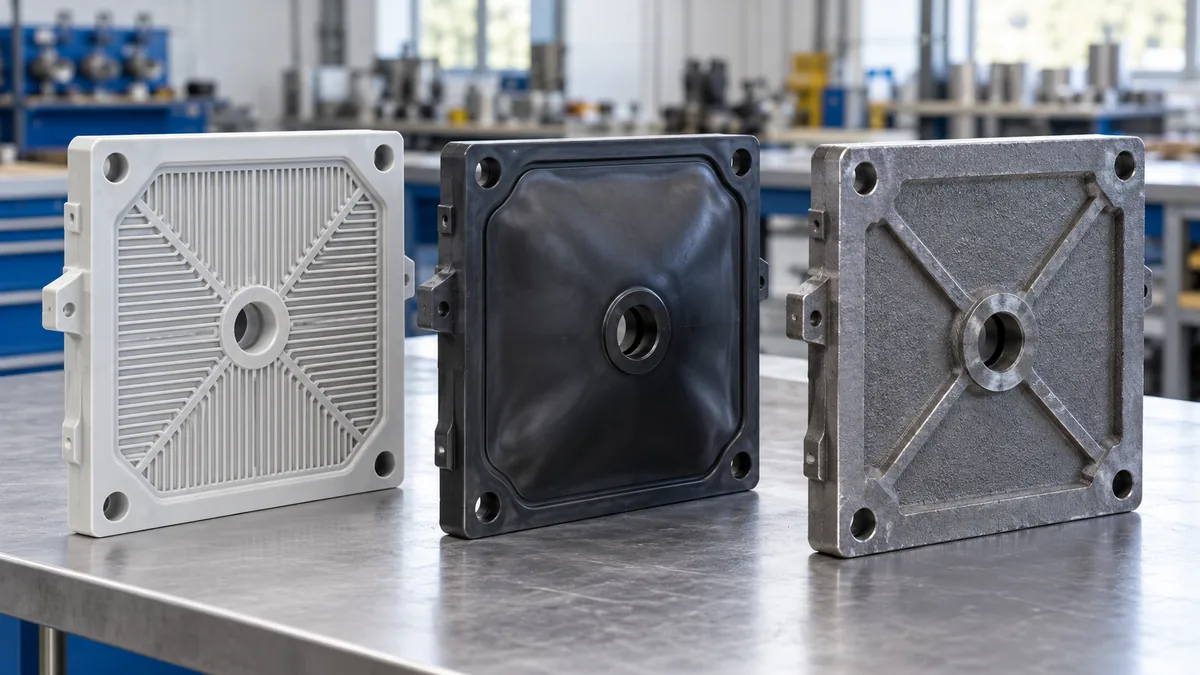
| PP filter plate | 85 °C | 1 to 13 | 0.8, 1.0 or 1.6 MPa | A press whose clamping requirement sits above the quoted class |
| HDPE filter plate | 60 °C | 1 to 14 | 0.6 or 1.0 MPa | Warm slurry, because the wider pH range does not extend the temperature limit |
| Cast iron filter plate | 150 °C | Neutral and weak alkaline only | 2.0 MPa allowable | Acidic duty, or a press with a weight constraint |
The table settles a question that price alone cannot. An HDPE plate covers a very wide pH range but stops at a low temperature, so a saving offered on that line is not available to a plant running warm slurry. Cast iron carries a high allowable pressure and temperature but gives up acid resistance. Rubber membrane plates add a squeeze stage at a listed range of 0.8 to 1.5 MPa and up to 75 °C, which is a different function rather than a cheaper version of the same plate. None of these materials ranks above the others in general; the duty decides.
The same restraint applies to cloth. Substituting a cheaper fabric of the same nominal grade changes blinding, cake release and cycle time together, and a trial conclusion covers only the cloth, the feed and the press that were tested. A performance figure obtained on one polymer family should not be carried across to another by analogy.
Keep a Comparison Record That Survives the Next Order
The comparison is only useful if it can be repeated when the next enquiry goes out. A short record does that work:
- Freeze the specification per item before requesting prices. Record polymer family and grade, dimensions, weight or thickness, filtration rating with its method, continuous temperature limit, pH range, pressure class and the acceptance checks you will run. A field left open is a field where the two offers will diverge.
- Record who declared each value and on what basis. A supplier declaration, catalogue data, your own measurement and a third-party report are four different levels of support, and merging them into one specification column hides the weakest link.
- Write the receiving checks beside the price. Dimensions, panel count, edge and seam condition, element end fittings and seal material, pad compression and deformation, markings and packaging condition. A receiving check without an acceptance criterion is a note, not a check.
- Fix the price basis. Currency, Incoterm, quantity break, freight responsibility, packaging and validity date, on the same sheet as the technical fields.
- Record a performance baseline for the item you are replacing: cycles completed to the agreed end point, filtrate clarity, cake moisture, and differential pressure trend where it applies. Without a baseline, a new offer cannot be shown to be better or worse.
- Re-quote only against the frozen specification. If a supplier changes grade, construction or basis, treat it as a new line with its own evaluation rather than a price change on the old one.
Compare the Next Quote Against a Fixed Field List
Send the next enquiry with the fields already filled in: product family, size or drawing number, polymer or alloy grade, filtration rating and the method behind it, continuous temperature and pH range, pressure class, quantity, delivery term, and the receiving checks you intend to run. Ask Shine Technology to complete the same fields for filter cloth, filter plates, cartridges and demister internals, so both offers start from one basis instead of two catalogues. Where a field is unknown on either side, mark it open and hold the award until it closes. The technical team can be reached through shinefiltration.com.
FAQ
Are two quotes with the same micron rating comparable?
Not on the rating alone. The figure may describe a woven aperture, a depth-filtration precision tied to a test dust, or a cartridge rating that is nominal rather than absolute. Before treating two ratings as equal, ask for the method, the test conditions and a second descriptor such as air permeability or areal weight. If the supplier cannot state the method, the number stays a declaration, and a sample comparison under your own feed is the only basis you can defend at award.
Should I compare price per piece or price per square metre?
Use the unit you actually consume and replace. Cut panels are consumed per piece, so a per-piece price that includes cutting and edge finishing is the practical basis, while roll goods are consumed per square metre. Convert both to cost per installed panel, then to cost per filtration cycle using cycles recorded against a stated end point. Comparing a per-piece price with a per-square-metre price rewards whichever offer happens to exclude more work.
How do I compare quotes when one supplier includes gaskets and hardware?
Move every included item onto its own scope line and give it a price or a stated exclusion, then do the same for the other offer. The resulting scope table explains most of the gap, because gaskets, handles, support grids, seals and fasteners are real costs that one side has absorbed and the other has not. Compare totals only on identical scope, or ask the narrower offer to quote the missing items before anything is ranked.
What should I do when a supplier will not state a test method?
Treat it as an open item and keep the number as a declaration. Ask for a sample and run a side-by-side check with written acceptance criteria: filtrate clarity, cycle time at the same feed pressure, cake release behaviour, and for cartridges the differential pressure after a stated loading period. Limit the conclusion to the samples, the feed and the equipment tested, and record those conditions with the result so a later order can be checked against them.
Does the lowest cost per filtration cycle always win?
No. Cost per cycle is one line in the decision. Lead time against your shutdown window, spare stock and storage conditions, fit risk on a replacement part, documentation for regulated production and the changeover time each option needs all affect the real comparison. A slightly higher cost per cycle with predictable lead time and documented material can be the better choice when a stoppage costs more than the media, but that judgment depends on your own downtime figures.