Electroplating Sludge Filtration: Cloth Compatibility Checks
Electroplating sludge filtration fails in ways a pH strip will not predict. A polypropylene cloth listed for pH 1 to 13 can still blind within a week on a chromate-bearing stream, and a polyester cloth rated to 120 °C can lose strength in the same duty at 45 °C. The reason is that a compatibility envelope describes a polymer in a generic aqueous environment, while plating sludge is a mixture of free acid or alkali, oxidisers, dissolved salts and fine hydroxide solids. This article sets out what to check, and in what order, so that cloth and plate are chosen on the actual filtrate rather than on one convenient number.
Why Does pH Alone Not Prove Cloth Compatibility?
A pH value describes the aqueous phase in contact with the cloth, and only that. It says nothing about oxidising strength, dissolved salt concentration, temperature, or the solids that build a cake on the surface. Two plating plants can report the same filtrate pH and place completely different demands on the same polypropylene fabric.
It helps to separate three failure routes that buyers often merge into the single word compatibility.
Chemical attack changes the polymer itself. Ester and amide linkages hydrolyse, oxidisers break chains, and fibre finishes or additives are extracted. The fabric loses mass or strength, and the change is usually slow enough that the first visible sign is a tear near a seam rather than a gradual loss of performance.
Physical fouling leaves the polymer intact but fills the pore structure. Metal hydroxide sludge is fine, compressible and frequently oily, so it blinds a depth medium long before the cloth is chemically weakened. This is a cleaning and construction question, not a chemistry question.
Mechanical wear comes from the press rather than the sludge: clamping load, cake discharge, high-pressure washing, and edge contact with plate ports and feed holes.
Each route needs a different test and a different corrective action. A pH number addresses the first route, and only part of it.
One measurement habit removes much of the ambiguity. Record pH and temperature at the press feed during the first minutes of filling and again at the end of the cycle, not from the equalisation tank where the sludge has been sitting and cooling.
Which Sludge Constituents Drive Material Choice?
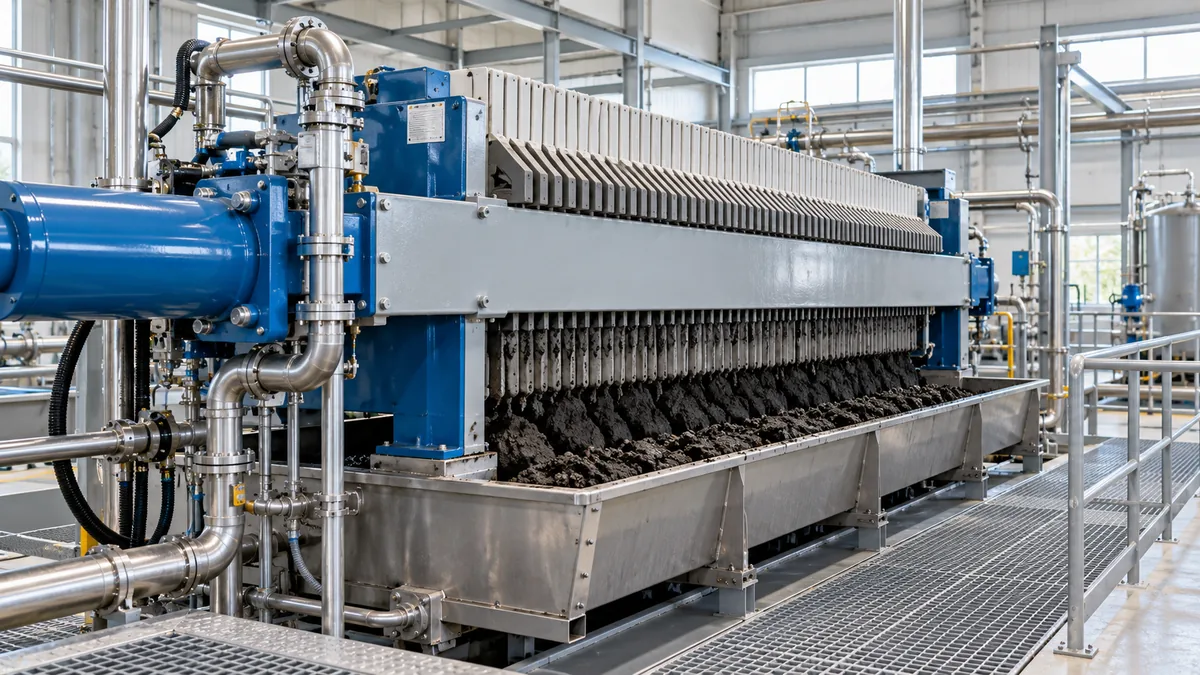
Neutralised plating sludge is mostly metal hydroxide solids suspended in a salt solution. The aggressive part is everything else in the stream, and those extras are exactly what a pH figure omits.
| Constituent or condition | What it does to the medium | What to confirm before ordering |
|---|---|---|
| Free acid, low pH | Hydrolyses ester and amide linkages, especially when warm | Filtrate pH at operating temperature, at start-up and at steady state |
| Chromium VI (chromate, chromic acid) | Oxidising attack on polymer chains, most severe when acidic and warm | Concentration, whether the stream is segregated, contact duration per cycle |
| Cyanide-bearing alkaline stream | Requires alkaline conditions, and is usually destroyed with an oxidiser | Whether hypochlorite or peroxide is dosed and what residual remains |
| Dissolved salts and chloride | Attacks metallic hardware, plate faces and support cages more than the cloth | Plate material, cage alloy, condition of drainage channels |
| Temperature | Softens the polymer, accelerates chemical attack and promotes creep under clamp load | Maximum and transient temperature at the cloth, not at the tank |
| Fine hydroxide solids and oil | Blinding, sticky cake, poor release and high wash demand | Solids loading, particle size, oil and grease, cake discharge behaviour |
Segregation matters as much as the analysis. Where chromate and cyanide streams are separated at source, the compatibility question narrows to the segregated stream and a wider choice of media becomes available for the remainder. Where they are combined before neutralisation, the cloth sees the mixture for the whole cycle.
How Do Polypropylene, Polyester and Nylon Compare Here?
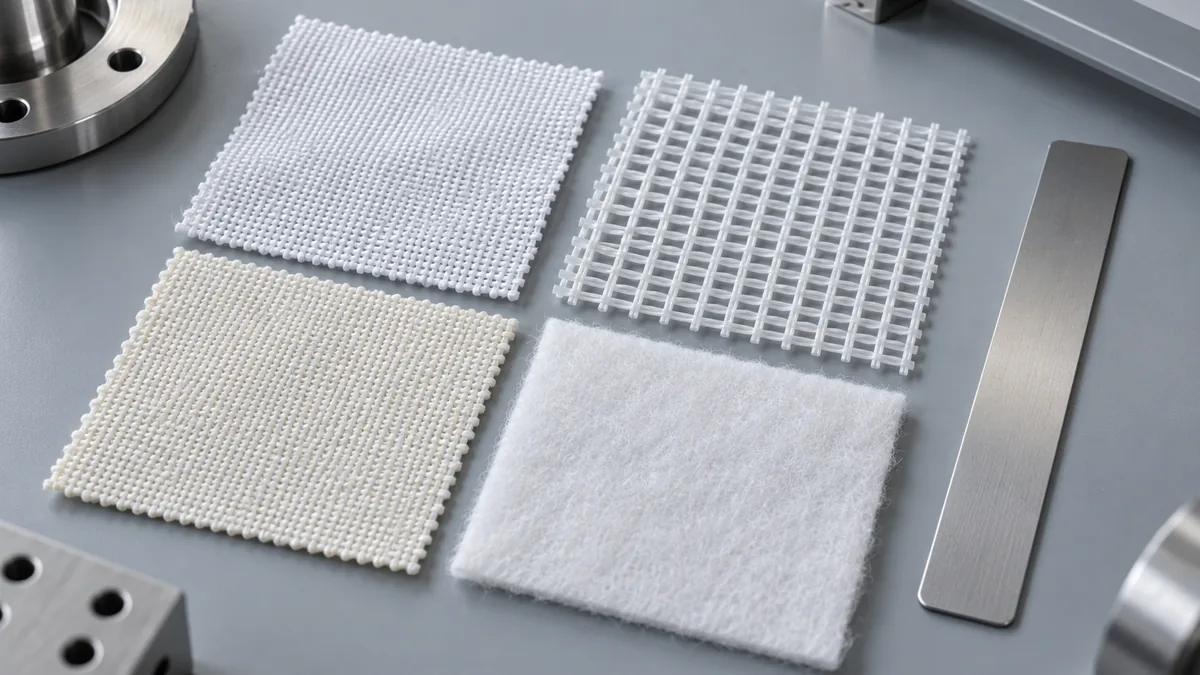
Published envelopes for the three common polymers overlap enough to look interchangeable on a quotation, and they are not. The table below uses typical supplier listings for woven multifilament cloth and adds the inference each figure does not support.
| Material | Listed pH envelope | Listed continuous temperature | Where it fits | Do not infer |
|---|---|---|---|---|
| Polypropylene (PP) | 1 to 13 | 85 °C, 90 °C transient | Acidic plating and pickling sludge, alkaline cyanide streams, routine wastewater duty | That a pH 1 listing survives hot chromic acid or hypochlorite; oxidiser strength sits outside the pH figure |
| Polyester (PET) | 4 to 9 | 120 °C, 130 °C transient | Neutral to mildly acidic, warm duties where thermal stability governs | That a higher temperature rating means broader chemistry; the pH window is narrower than PP |
| Nylon (PA) | 5 to 11 | 100 °C, 110 °C transient | Abrasive, weakly alkaline solids where cloth wear sets service life | That nylon is a general upgrade; concentrated strong acid weakens it |
| PP monofilament | 1 to 13 | 85 °C, 90 °C transient | Granular or crystalline solids in acid duty where cake release drives cycle time | That monofilament is finer; the listed aperture range extends coarser than multifilament grades |
| Non-woven needle felt | Set by fibre and finish, not by construction | Set by fibre choice | Fine hydroxide capture at high solids loading where filtrate clarity is the priority | That non-woven is a chemistry; ask which fibre and which functional treatment |
Two conclusions follow from the table. Polypropylene usually becomes the default for acid plating sludge because its pH window covers the common duty at a temperature most plating plants already meet. Polyester earns its place only when the stream is genuinely neutral to mildly acidic and heat is the binding constraint. Nylon is a wear answer, not a chemical one, and it should not be selected for an acidic duty on abrasion grounds alone.
Construction then sits on top of chemistry. A woven multifilament gives a stable pore structure and predictable capture. A monofilament woven cloth releases cake more completely because particles cannot embed in a smooth filament, which matters when the sludge is sticky. A non-woven needle felt trades release behaviour for depth capture and dirt-holding capacity, which suits fine hydroxide solids but demands more attention to cleaning. Selection should follow the stream, not the other way round.

When Does Temperature Decide Before Chemistry?
Temperature and chemistry are usually treated as separate lines on a data sheet. In practice one of them binds first, and identifying which one saves a pointless material debate.
Consider a stream at pH 2.5 and 45 °C. Polyester is chemically outside its envelope, so its 120 °C rating is irrelevant and the discussion ends. Now consider the same chemistry at 88 °C. Polypropylene is inside its pH window but outside its 85 °C continuous limit, so the constraint has moved from chemistry to heat, and the answer is a different press configuration or feed cooling rather than a different polymer.
Plating plants reach those temperatures more often than buyers expect. Electroless nickel solutions are held near boiling, so the sludge from that line can arrive at the press close to or above the continuous limit of standard polypropylene. Drying and rinsing stages add heat to the feed. A pump adds a little more.
Two effects make an overshoot worse than it looks. The first is creep: a thermoplastic cloth held above its softening range slowly loses the tension that keeps it seated against the plate, and a loose cloth wrinkles, wears at the edges and leaks. The second is acceleration: chemical attack that would take months at 40 °C can compress into weeks at 90 °C, so a cloth that passed a bench immersion check at room temperature may still fail in service.
Check the transient figure as well as the continuous one. A 90 °C peak listed for polypropylene is a short excursion allowance, not a licence to run a 90 °C feed all day.
Does the Filter Plate Set the Same Limits as the Cloth?
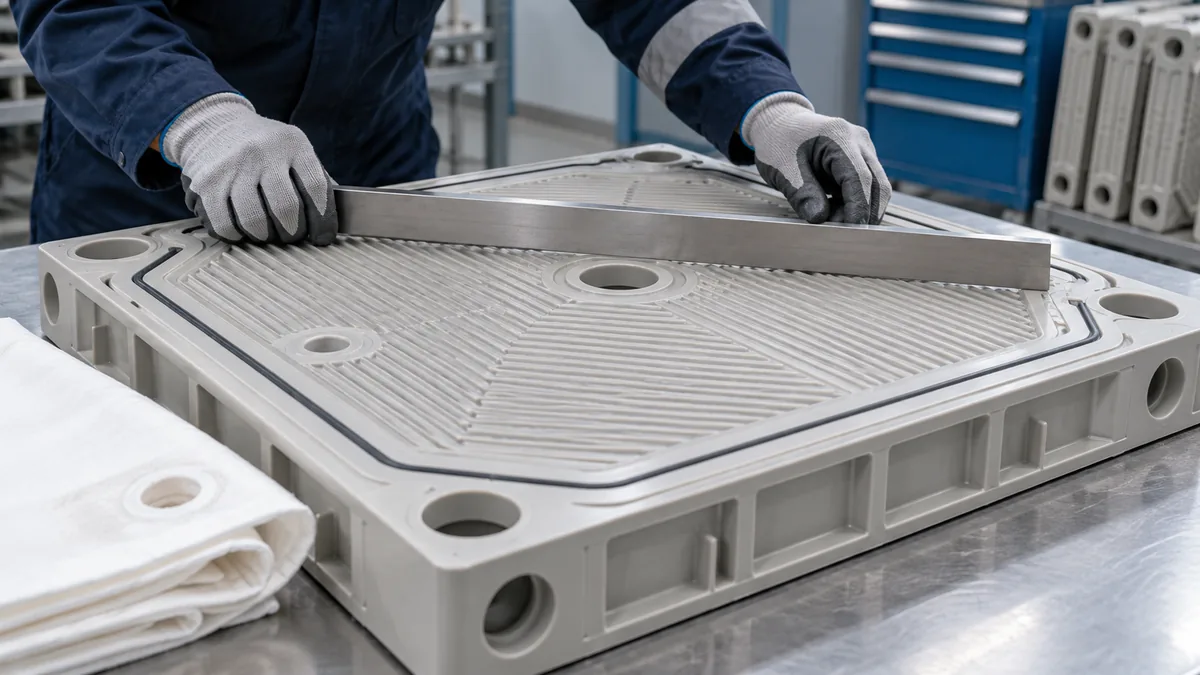
Frequently the plate is the weaker link, and a compatibility review that examines only the cloth misses it.
| Plate or membrane | Listed pH | Listed continuous temperature | What it means for plating sludge |
|---|---|---|---|
| Polypropylene plate | 1 to 13 | 85 °C | Matches PP cloth and covers most acid plating duty; the usual pairing |
| HDPE plate | 1 to 14 | 60 °C | Widest pH range with the narrowest temperature margin; suits cold aggressive streams |
| Cast iron plate | Neutral and weak alkaline only | 150 °C | Not acid resistant at any cloth choice; a real constraint on acidic plating sludge |
| Rubber membrane plate | 2 to 12 | 75 °C | Squeeze improves cake dryness but narrows both the pH and temperature envelope versus a plain PP plate |
The cast iron row deserves attention because it inverts the usual conversation. A plant running an acidic stream on a cast iron press has a plate problem that no cloth will solve, and the visible corrosion on sealing faces is often misread as cloth leakage.
The membrane row carries a subtler trade. Adding squeeze reduces cake moisture and shortens the cycle, and it also introduces a rubber surface with a pH floor of 2 and a 75 °C ceiling. If the stream sits at pH 1.8, the membrane option disappears regardless of how attractive the dryness result looks on paper.
Metallic hardware belongs in the same review. Support cages, handles, bolts and drainage fittings see the same chloride-bearing liquid as the cloth, and pitting there contaminates the filtrate and damages the plate face.
Which Questions Turn a Compatibility Claim into a Specification?
A supplier statement that a cloth is suitable for plating sludge cannot be compared with another supplier’s statement of the same kind. Converting it into a specification takes six items, and all six belong in the enquiry.
- Full pH range of the filtrate, measured at operating temperature, including the first minutes of the cycle.
- Maximum and transient temperature at the cloth, taken at the press feed.
- Presence and concentration of oxidisers, specifically chromate, hypochlorite and peroxide, plus whether those streams are segregated.
- Solids loading, particle size range, and oil or grease content of the sludge.
- Plate and membrane material already installed, with its own pH and temperature limits.
- Agreed trial acceptance criteria, written before the cloth is ordered.
The contrast between a vague request and a usable one is easy to see.
A line reading “polypropylene filter cloth, suitable for plating sludge” cannot be evaluated. The replacement line reads: polypropylene multifilament, plain weave, grade within the 8 to 50 μm range, pH confirmed against a filtrate sample at 55 °C, maximum continuous temperature 85 °C, chromium VI present at the stated concentration, trial accepted on filtrate suspended solids and cycle time.
Where a chemical claim needs independent support, ASTM D543 [1] sets out immersion practices for plastic specimens: mass change, dimensional change and retained mechanical properties after a defined exposure. The practice is written for plastics rather than for a woven fabric, so treat it as a measurement model to borrow, and treat the immersion result as a screening step rather than a service prediction.
Supplier data should be read with the same discipline. Shine Technology publishes its polypropylene cloth envelope as pH 1 to 13 and 85 °C continuous, which is a screening boundary for aqueous duty, not a statement about oxidiser resistance at plating concentration. Any supplier who answers the oxidiser question directly is giving you something more useful than a wider pH window.
What Should a Cloth Trial Record Before You Order?
A trial without recorded criteria becomes an opinion. Fix the measurements before installation so the result can be repeated when the next batch of sludge arrives.
Filtrate quality: suspended solids or turbidity at a fixed point in the cycle, compared against the incumbent cloth under the same feed.
Hydraulic behaviour: fill time, filtration time and total cycle time, recorded per cycle rather than as a weekly average.
Cake: moisture content and release behaviour, including whether the cake leaves cleanly or requires manual scraping at any position.
Cloth condition: mass per unit area to ASTM D3776 [4], thickness, and appearance at seams, edges and feed holes.
Permeability retention: air permeability to ASTM D737 [2], measured on a new sample and on the same cloth after a defined number of cycles, which shows how much open area the sludge has taken.
Strength retention: breaking force and elongation to ASTM D5035 [3], which catches chemical damage that a visual inspection misses.
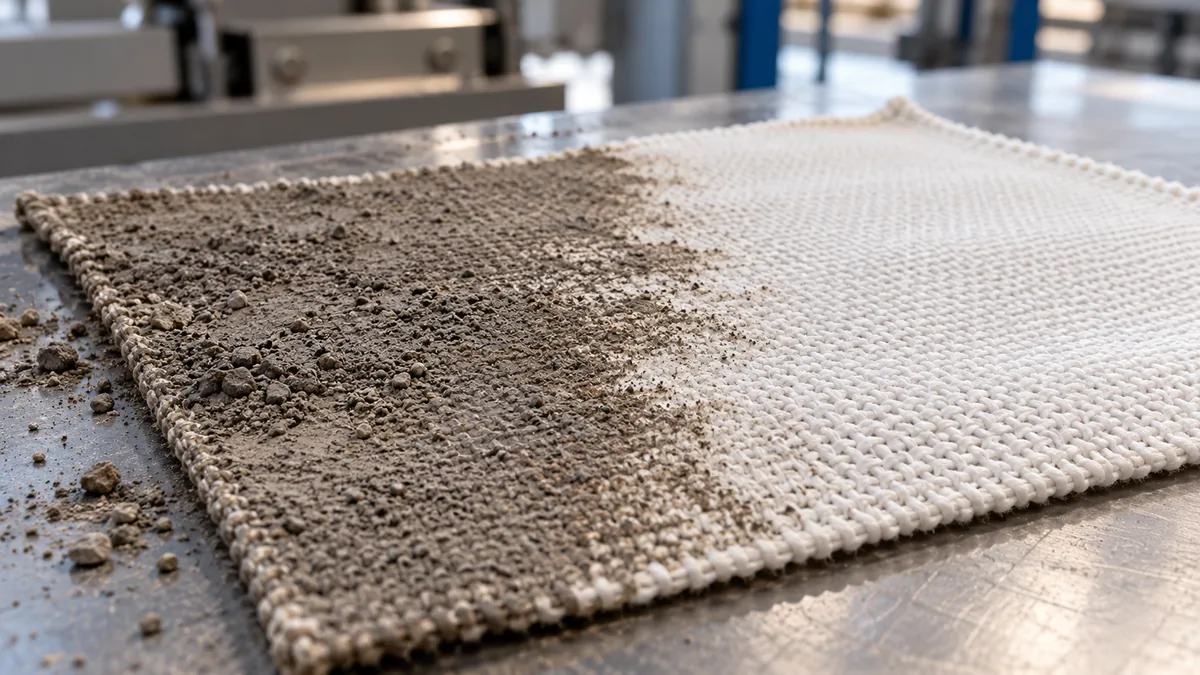
Cleaning recovery: permeability after the site’s normal wash routine. A cloth that returns close to its clean value is fouling; a cloth that stays low is blinding, and the answer lies in construction, surface finish or pre-treatment rather than in the polymer.
Record the position of any failure in the stack. Damage that repeats at the same plate points to a port, a burr or a sealing face, and replacing the cloth will not change it.
What to Send with a Cloth and Plate Enquiry
Send the filtrate analysis, the temperature record from the press feed, the oxidiser and cyanide details, the installed plate material and its pressure class, and the trial criteria you intend to apply. Those five items let a supplier answer the question you actually asked instead of quoting a polymer by name. Shine Technology reviews plating sludge enquiries against exactly these fields, and a request that arrives with the filtrate data and the press details attached can be matched to a cloth grade and plate configuration on the first reply rather than the third. Include the position of any repeat failure in the stack, since that often changes the recommendation before the material does.
FAQ
Can polyester filter cloth be used for chromic acid waste?
Generally no. Chromium VI in acidic solution is an oxidiser, and polyester is more vulnerable to oxidising attack than polypropylene, even though its temperature rating is higher. The listed polyester window of pH 4 to 9 does not describe oxidiser strength at all, so a chromate stream can sit inside that pH band and still degrade the fabric. If the stream contains chromate, start from polypropylene and confirm the concentration and temperature before committing to a trial.
Is a pH 1 to 13 cloth safe for every plating sludge?
No. The window describes aqueous acid and alkali resistance for a polymer, not resistance to oxidisers, solvents, high chloride levels or elevated temperature. A cloth can be inside its pH range and outside its thermal limit, or inside both and still blind within days on fine hydroxide solids. Treat the pH figure as a screening filter that removes obviously unsuitable materials, then qualify the shortlist against the actual filtrate.
Why does polypropylene cloth blind so quickly on plating sludge?
Blinding is usually a solids and oil problem rather than a chemical one. Metal hydroxide sludge is fine, compressible and often carries grease from the plating line, so particles pack into the pore structure and resist the wash routine. A depth structure such as needle felt captures well but holds onto what it captures. Check permeability recovery after cleaning; if it stays low, review surface finish, construction and pre-treatment rather than changing polymer.
Do I need a membrane plate for plating sludge?
Only if cake dryness or cycle time is the constraint and the stream sits inside the membrane envelope. Rubber membranes are typically listed at pH 2 to 12 and 75 °C, which is narrower than a plain polypropylene plate. On a strongly acidic or warm stream, adding squeeze can remove the plate option entirely. Confirm the plate limits against the filtrate first, then decide whether the dryness gain justifies the reduced headroom.
References
[1] ASTM D543, “Standard Practices for Evaluating the Resistance of Plastics to Chemical Reagents,” ASTM International, West Conshohocken, PA, USA, 2021.
[2] ASTM D737, “Standard Test Method for Air Permeability of Textile Fabrics,” ASTM International, West Conshohocken, PA, USA, 2018.
[3] ASTM D5035, “Standard Test Method for Breaking Force and Elongation of Textile Fabrics (Strip Method),” ASTM International, West Conshohocken, PA, USA, 2019.
[4] ASTM D3776, “Standard Test Methods for Mass Per Unit Area (Weight) of Fabric,” ASTM International, West Conshohocken, PA, USA, 2020.