Rubber Membrane Filter Plates: Setting the Squeeze Pressure
A rubber membrane filter plate does its best work somewhere below its maximum squeeze rating. The plate data tells you what the membrane can tolerate, typically a band such as 0.8 to 1.5 MPa for a reinforced rubber or EPDM plate, but the useful setting is decided by what the cake will release, how quickly the filtrate can leave, and how much separating force the press frame can hold shut. Push past that point and the gauge moves while cake moisture barely changes, with the membrane absorbing the difference as fatigue. Matching squeeze pressure to the application starts with three numbers you can measure and one you should not guess.
What the Squeeze Stage Actually Does to the Cake
Filtration fills the chamber and leaves a cake that still holds liquid in the voids between particles. The squeeze stage changes geometry rather than chemistry. Air or water pressurizes the cavity behind the membrane, the membrane deflects into the chamber, and the chamber volume shrinks. Liquid leaves through the cloth into the drainage surface of the plate and out through the filtrate outlets.
Two things happen to the cake at once. The particle bed compacts, so the void space between particles gets smaller and the liquid held there is pushed out. The cake also consolidates against the cloth, which usually improves discharge because the cake leaves as a firmer, more coherent slab.
How much the cake gives up depends on what it is made of. Biological and chemical sludges, pigment residues and many hydroxide sludges are compressible, so a moderate squeeze removes a worthwhile share of the remaining liquid. Crystalline and mineral solids with hard particles compact less; the bed reaches a limit and further pressure mostly loads the membrane and the frame.
That limit is why pressure makes a poor control variable on its own. Once the bed is consolidated, added squeeze pressure finds the weakest path. It can open fissures near the cake edge, press the cake harder into the cloth, or simply hold load against a drainage surface that has already closed.
The Two Pressure Limits That Decide the Setting
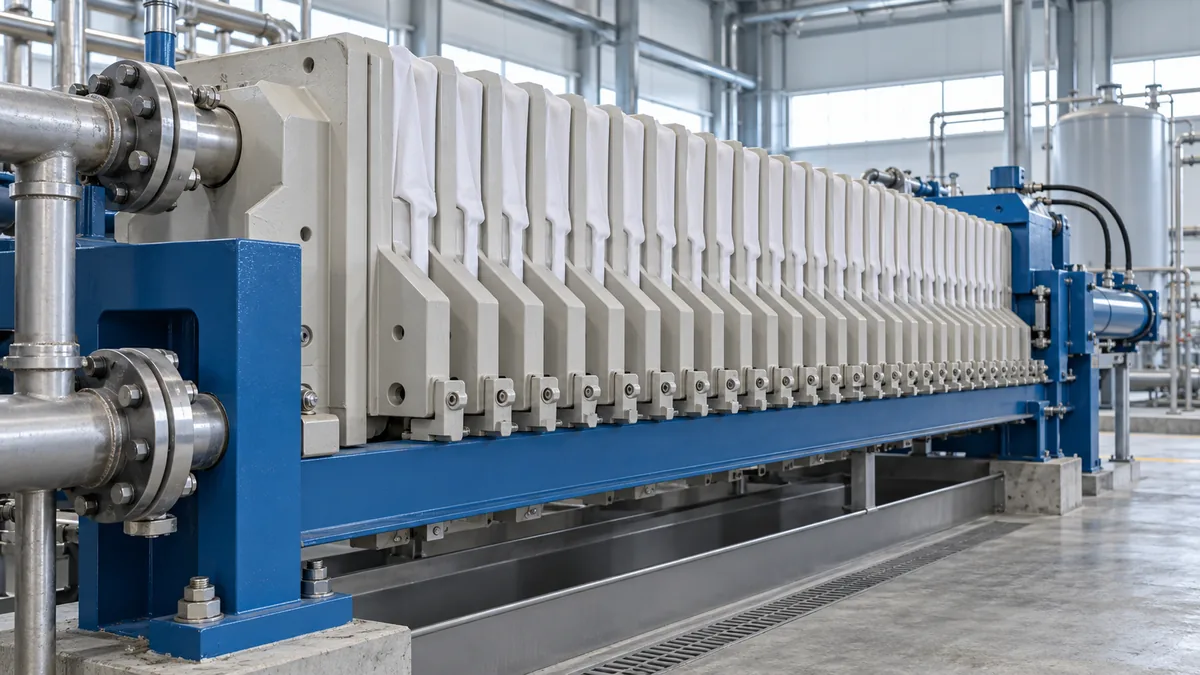
The first limit appears on the plate data. Rubber membrane plates are commonly listed with a squeeze range of 0.8 to 1.5 MPa, continuous service to about 75°C and a pH band of roughly 2 to 12. Those figures describe what the membrane compound and the vulcanized bond are built to survive.
The second limit belongs to the press rather than the plate. During squeeze, internal pressure pushes the plates apart, and the hydraulic clamping system must hold the stack closed against that force plus the feed pressure. A press clamped for a modest filtration pressure may not contain a squeeze at the top of the plate range, especially on large plate sizes where the same pressure acts over a bigger area. Slurry weeping at the plate edges during squeeze is one sign that the clamp is losing that contest.
The practical setting is the lower of the two, then adjusted for drainage. If the drainage path is restricted, the membrane pushes against a nearly incompressible volume and the pressure has nowhere useful to go.
Pressure and moisture records carry different weight, and it helps to know which is which before a trial begins.
| Record | How it is obtained | What it can support | What it cannot establish |
|---|---|---|---|
| Listed squeeze range of 0.8 to 1.5 MPa | Plate manufacturer data | That the membrane and its bond are built for this band | That your press, cloth and cake can use the top of it |
| Squeeze gauge reading | Panel gauge or logged trend | The pressure applied at the manifold | The pressure that reached the cake face after losses in the drainage path |
| Cake moisture after discharge | Sample dried by your agreed method | A comparison between cycles on the same feed | A performance claim against another supplier’s plate |
| Membrane surface condition | Inspection after discharge | Whether blistering, cracking or hardening is present | The root cause without pressure, temperature and pH records |
These records describe your own press and your own feed. They support decisions about this installation, and they do not transfer to another slurry, another plate size or another membrane compound without a new trial.
Matching Squeeze Pressure to the Slurry
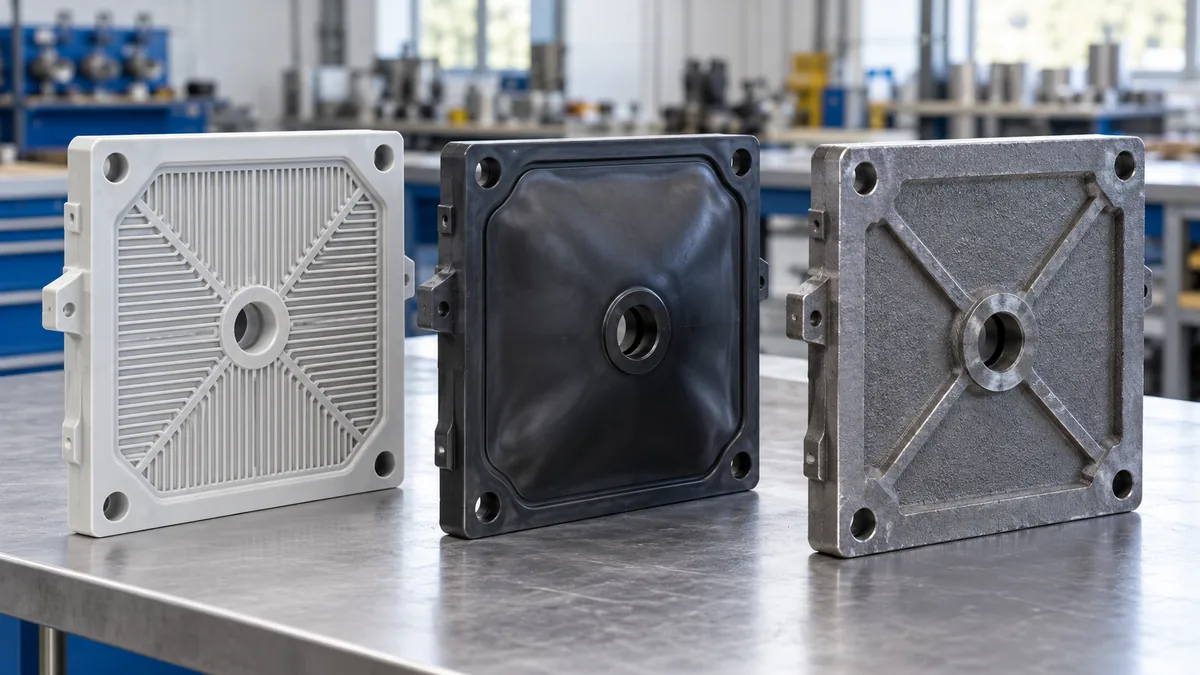
Compressibility is the property that decides whether squeeze earns its place. A compressible cake keeps losing volume as pressure rises, so the moisture curve falls steadily and a mid-range setting is often enough. An incompressible cake flattens early, and the difference between a low and a high squeeze shows up as membrane wear rather than drier cake.
Solids concentration and cake thickness matter as much as particle character. A thicker cake in a deep chamber holds more liquid and needs a longer squeeze at a moderate pressure rather than a short burst at maximum. Thin cakes in shallow chambers respond quickly and can be over-compressed before the operator notices.
The way to settle the question is a stepped trial on the same feed, not a single run at a guessed pressure. Run three cycles at three pressure levels with the same slurry batch, the same cloth and the same cycle timing. Record cake moisture by the agreed method, note where the sample was taken, and log the filtrate flow from individual outlets during each squeeze. If the gain between the second and third step is small while the membrane edge shows stress or the cycle lengthens without benefit, the lower step is your setting.
Air or Water as the Squeeze Medium
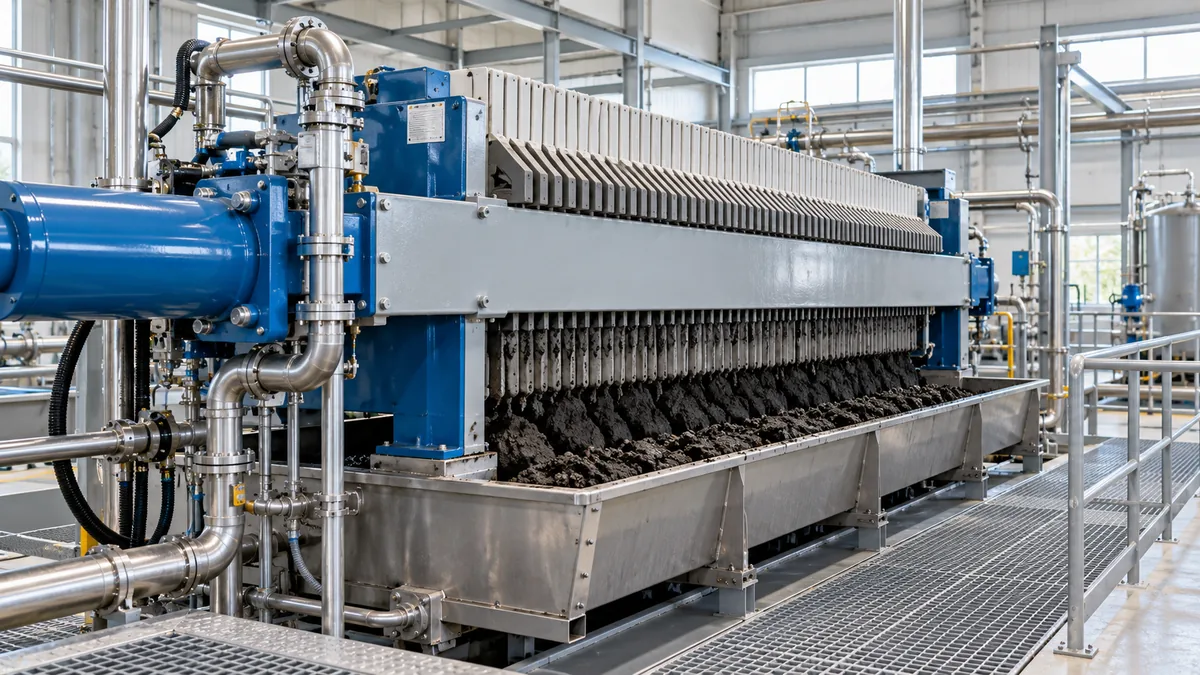
Both media pressurize the same cavity, and both produce a genuine squeeze. The difference lies in how the pressure is delivered and what happens when something goes wrong.
| Aspect | Air squeeze | Water squeeze |
|---|---|---|
| How pressure builds | A compressor charges the cavity and pressure rises quickly | A pump fills the cavity with water and pressure follows the pump setting |
| Uniformity across the plate | Pressure equalizes, but compressible air stores energy | An incompressible medium loads the membrane evenly |
| Release behavior | Fast venting can shock the membrane | Staged release is easier to control |
| Failure mode | A puncture releases stored energy and can damage the plate face | A leak appears as water at the plate edge or in the filtrate |
| Where it fits | Plants with reliable instrument air and moderate pressure needs | Plants needing steady, repeatable pressure or higher settings |
The choice also affects the specification you send a supplier. Air and water cavities use different fittings, and a plate built for one medium is not automatically suitable for the other at the same pressure.
Ramp, Hold and Release in the Pressure Profile
The pressure profile matters as much as the peak. A membrane that is brought to full squeeze in one step flexes sharply at the clamped edge, where movement concentrates, and that edge is where most membrane failures begin. A staged ramp gives the cake time to consolidate and gives the membrane a gentler path to its working deflection.
Hold time should follow the filtrate, not the clock. Watch the outlet flow during the hold. When flow has nearly stopped for a stable interval, the squeeze has done most of what it can, and extending the hold mainly adds cycle time. When flow continues, the cake is still yielding and a longer hold is justified.
Release deserves the same attention as the ramp. Venting air suddenly leaves the membrane to snap back under its own stored energy, and repeated snapping hardens the rubber. Returning water pressure in a single step can produce a pressure surge through the cavity. A controlled release over a defined interval costs seconds and protects the part that is expensive to replace.
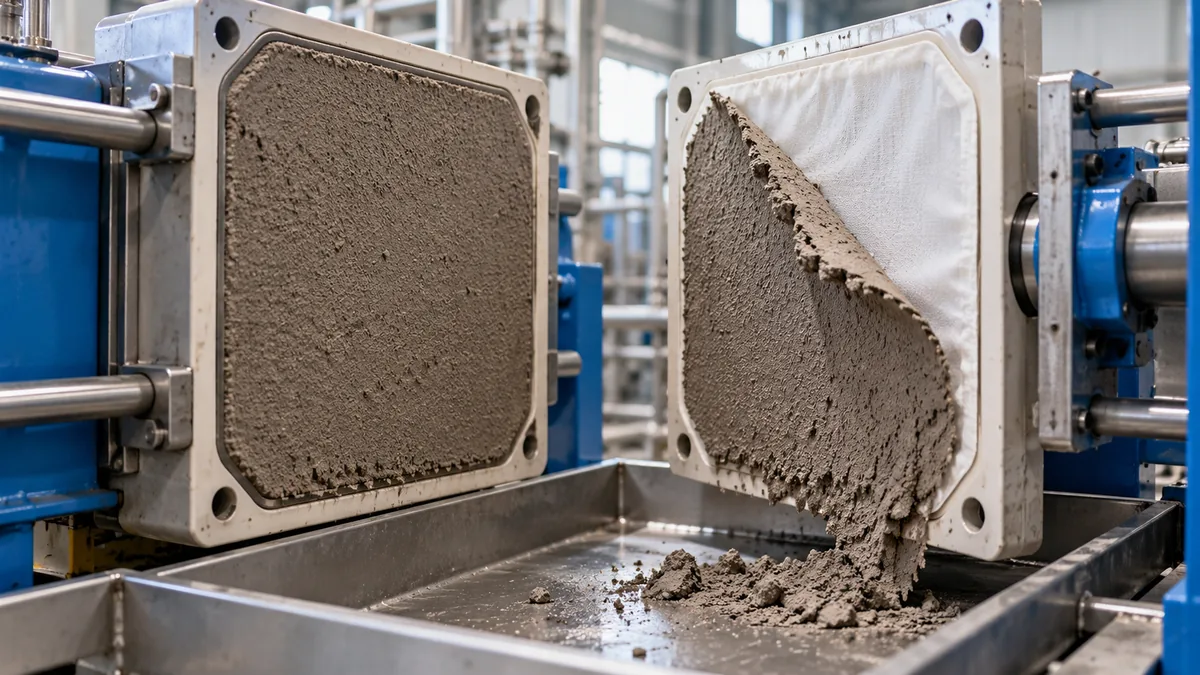
Check cake release immediately after discharge. A cake that clings in patches, or leaves a ring of compacted solids on the cloth, is telling you the squeeze went further than the cake needed.
What Limits Squeeze Pressure More Than the Membrane Rating
Drainage capacity is the most common bottleneck. Filtrate leaves through the cloth, crosses the drainage channels on the plate face and exits through the outlet. Blocked channels, a blinded cloth or scale in the outlet restrict that path, and the squeeze then compresses a cake whose liquid has nowhere to go. Raising pressure in that condition increases load without reducing moisture.
Temperature is the second constraint. Rubber stays elastic within its service band, but continuous operation near the upper limit softens the compound and accelerates compression set, so the membrane stops recovering fully and cake thickness becomes uneven across chambers.
Chemistry decides which rubber is appropriate. Natural rubber and EPDM behave differently across the same pH range, and chloride, solvent or oxidizer exposure can matter more than pH alone. The listed 2 to 12 pH band for the rubber plate range covers the broad case, not every chemical in it.
Plate condition closes the list. A sealing face with trapped solids, a membrane lifting at its attachment, or a plate that has warped in hot service will leak or deflect unevenly long before the squeeze pressure reaches its rating.
Signs That the Squeeze Pressure Is Mismatched
Symptoms are more useful than a single reading because they show where the mismatch sits.
| Symptom | Likely contributor | First check |
|---|---|---|
| Cake moisture varies from chamber to chamber | Uneven membrane deflection or restricted drainage on some plates | Compare filtrate flow from individual outlets during squeeze |
| Membrane blistering or cracking near the feed port | Pressure spikes, fast ramping or overpressure | Review the pressure trend and the ramp setting |
| Slurry weeping at plate edges during squeeze | Clamping force below the separating force | Compare clamp pressure with squeeze pressure and plate area |
| Cake adhering to the cloth after squeeze | Over-compaction of a compressible cake | Reduce squeeze pressure and inspect release at discharge |
| No moisture change when pressure is raised | Consolidated cake or blocked drainage | Check cloth permeability and drainage channels before raising pressure again |
Treat these as candidate causes until the records confirm one. A blister and a blocked outlet can produce the same moisture complaint, and the checks required to separate them are different.
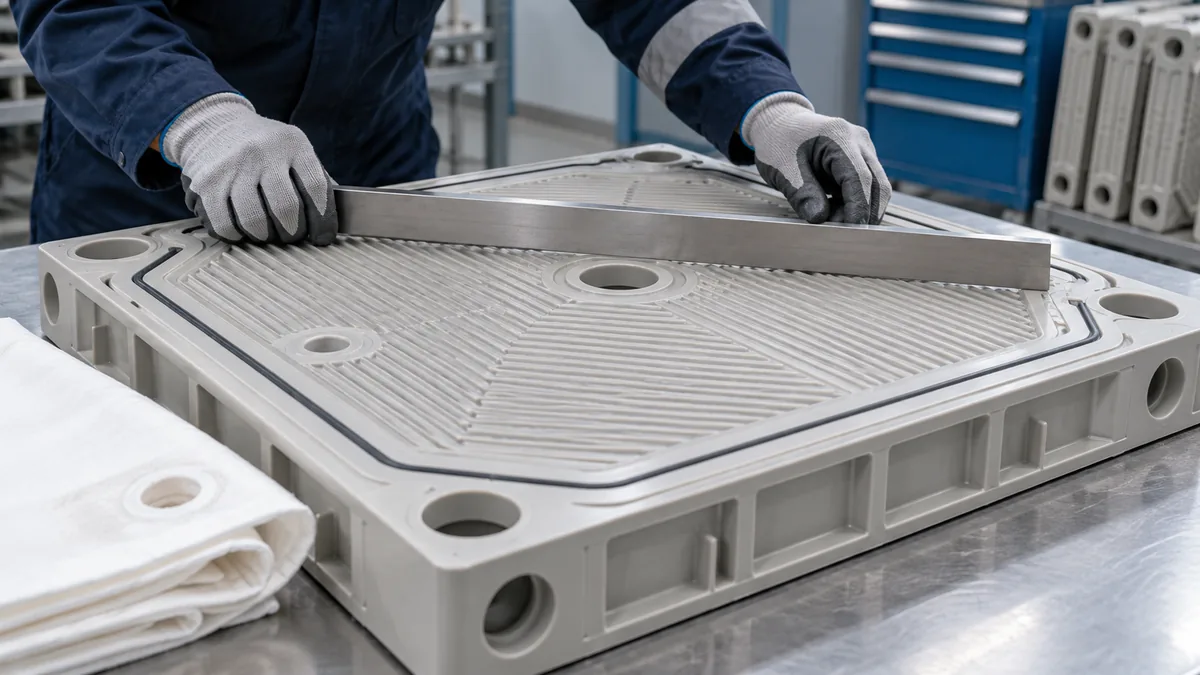
Specifying a Rubber Membrane Plate for Your Press
A membrane plate order that leaves the supplier guessing will be filled with reasonable assumptions, and those assumptions are where fitting problems start. The details below are the ones that change the delivered part.
| Field | What to send | Why it matters |
|---|---|---|
| Press and plate size | Plate dimensions, chamber depth, membrane side | Fits the existing stack and the hydraulic envelope |
| Squeeze medium and pressure | Air or water, planned operating pressure, ramp | Membrane and fitting selection follow the medium |
| Cake target | Required moisture and the method used to measure it | Defines whether squeeze can deliver the target |
| Process conditions | Temperature range, pH range, chloride or solvent exposure | Sets the rubber compound choice |
| Feed details | Solids content range, particle character, cycle time | Indicates how compressible the cake is likely to be |
| Interface details | Feed port and filtrate outlet layout, existing drawing | Prevents a correct plate arriving with the wrong ports |
An inquiry that reads “one rubber membrane plate, 1250 mm, 1.5 MPa” leaves the compound, the medium and the port layout to be guessed. A usable inquiry states press size, chamber depth, membrane side, squeeze medium and planned pressure, the temperature and pH range, the cake moisture target with its test method, and attaches the existing plate drawing or a clear photograph of the port face.
Shine Technology’s rubber membrane plate data, for example, lists a 0.8 to 1.5 MPa squeeze range, continuous service to 75°C and pH 2 to 12, which is enough to start a conversation about a low-temperature municipal sludge duty and not enough to confirm a plate for a hot, chloride-bearing slurry without the process figures.
Send Your Press Data for a Membrane Plate Review
Tell us the press size, plate dimensions, chamber depth, membrane side, squeeze medium and planned pressure, the temperature and pH range, the cake moisture target and the method used to measure it, and the feed port and outlet layout. Include the existing plate drawing or clear photographs of the port face where one is available. Shine Technology reviews those details against the rubber membrane plate range and replies with the compound, plate size and pressure profile that fit your press rather than a plate that merely matches the dimensions. Reach the technical team through the contact details on shinefiltration.com and include the cycle records from your last squeeze trial if you have them.
FAQ
Can a rubber membrane plate run at the top of its squeeze range all the time?
Only when the press clamp, the drainage path and the cake all support it. Sustained top-of-range operation shortens membrane life even on a suitable press, because the membrane stays at maximum deflection through every cycle and recovers less completely between them. If the application needs the top of the range, confirm the clamping force first and check filtrate flow during the hold, since a restricted outlet turns that pressure into load without dewatering benefit.
How do I check whether the squeeze pressure reached the cake?
Compare three things during a cycle: the manifold gauge reading, the filtrate flow from individual outlets, and the cake moisture sampled by position after discharge. If the gauge holds steady while outlet flow stops early and moisture stays high near the plate centre, the pressure is not reaching the cake evenly. Losses usually sit in a blinded cloth, blocked drainage channels or a membrane that no longer deflects across its full face.
Does a membrane plate always produce a drier cake than a recessed chamber plate?
No. The gain depends on cake compressibility, available drainage and cycle time. Compressible sludges such as biological and hydroxide sludges usually show a clear improvement, while hard crystalline solids may show very little for the added capital and membrane maintenance. A stepped trial on your own feed is the only reliable way to know which case you have before committing to a membrane press.
Which temperature and pH limits matter for a rubber membrane?
For the listed rubber membrane plate range, continuous service is 75°C with a transient limit near 80°C, and the pH band is 2 to 12. Exceeding either shortens membrane life in ways that appear as hardening, swelling or edge cracking rather than an immediate failure. Chloride, solvent and oxidizer exposure can matter more than pH alone, so include those details when a compound is selected.