Choosing Filter Press Consumables for Acidic Pickling Sludge
Acidic pickling sludge is one of the least forgiving feeds a filter press sees. pH commonly sits between 1 and 3, chloride levels are high, and the solids are fine iron-rich hydroxide particles that pack into a medium and hold water. For this duty, filter press consumables are chosen in a fixed order. Chemistry first, because polypropylene cloth and plate materials stay intact where polyester and cast iron do not. Temperature second, because many pickling lines run warm enough to push a polymer toward its listed limit. Aperture, weave and squeeze come last, and they decide cycle time and cake moisture rather than survival.
What Makes Acidic Pickling Sludge Hard on Filter Press Consumables
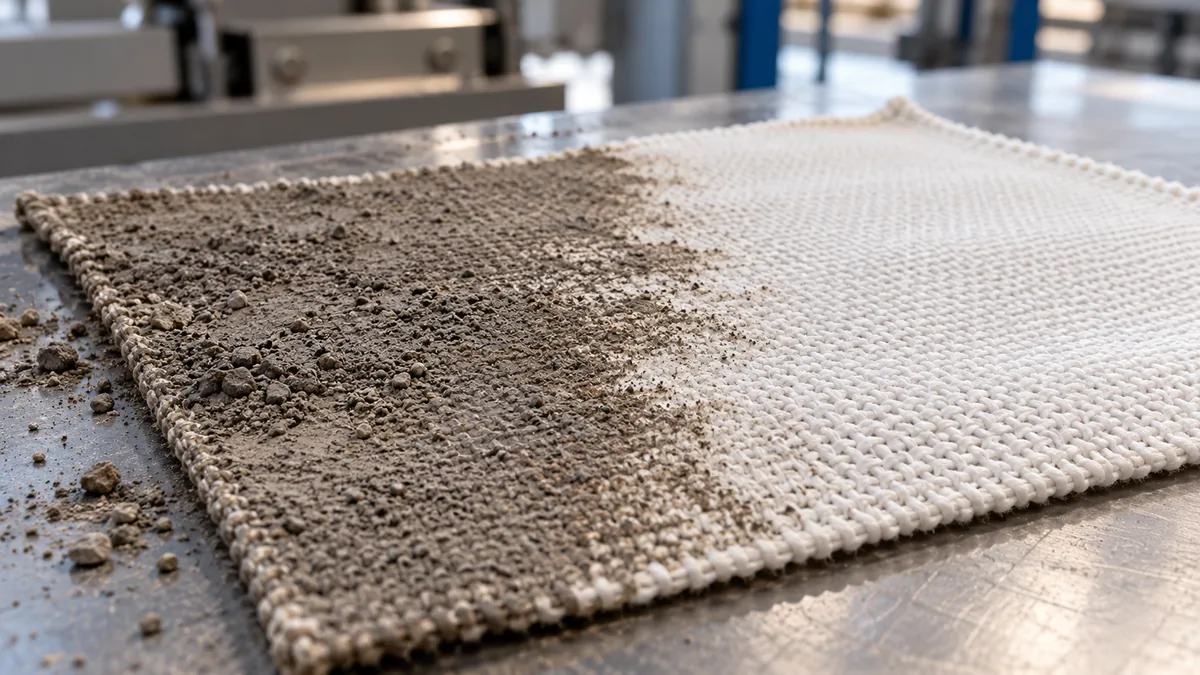
Pickling liquor neutralization produces a sludge that attacks consumables along two paths at once. The chemical path is the familiar one. Free acid and dissolved chloride attack polymer chains and metal surfaces, and the attack continues while the press sits idle between cycles. The physical path is quieter. Iron hydroxide and, where lime is used for neutralization, calcium sulfate precipitate as fine particles that fill the pore openings of a medium and trap water inside the cake. A cloth can blind long before it shows visible wear.
Material choice therefore sets the ceiling on service life, and the data sheets already answer the first question. Polypropylene cloth is listed from pH 1 to 13, which covers raw pickling liquor. Cast iron plate data lists neutral and weak alkaline service only and claims no acid resistance, so a cast iron stack on this duty loses its sealing faces to corrosion long before it loses mechanical strength. Polyester, listed from pH 4 to 9, becomes workable only after the liquor is neutralized into that band.
Temperature is the second gate. PP cloth carries a listed continuous limit of 85 °C and a transient limit of 90 °C, and PP plates share the same 85 °C ceiling. Read the temperature at the press feed rather than at the pickling tank. A pump, a holding tank and an uninsulated line can move it in either direction, and a warm feed narrows the choice quickly.
Failure on this duty rarely announces itself as a hole. Filtrate stays clear while fill time stretches from cycle to cycle, and the usual response is more feed pressure or higher clamping force. That extra differential pressure lands on the cloth at the feed port and on the plate sealing face, and a blinding problem becomes a tear or a leak. Consumable selection for pickling sludge starts with the material envelope, not with the micron rating.
| Record | Basis | What it supports | What it does not support |
|---|---|---|---|
| PP cloth listed at pH 1 to 13 | Supplier material envelope for the polymer | Screening cloth chemistry against a pH 1 to 3 liquor | A service life estimate in chloride-rich liquor near the temperature limit |
| Plate rated 1.0 MPa | Plate pressure class for the press design | Matching the plate to the press clamping and squeeze system | Tolerance of a 1.0 MPa differential across a blinded cloth |
| Cloth rated 25 μm | Nominal aperture basis for one weave family | Comparing candidates inside that weave family | Retention of every 25 μm particle in the feed |
| Membrane squeeze range 0.8 to 1.5 MPa | Membrane inflation range for that plate | Setting the squeeze stage inside the membrane rating | That the same membrane suits filtrate at pH 1 to 2 |
None of these limits is a defect in the data. Each answers a narrower question than the one buyers usually ask, and the gap between the two is where a trial belongs.
Which Filter Cloth Chemistry Survives Pickling Liquor
Polypropylene is the default chemistry for raw pickling liquor, and the real choice inside PP is about cake release and cleaning rather than survival. Multifilament PP is the general duty option, with listed models covering 8 to 50 μm. Monofilament PP opens the aperture range to 120 μm and gives up some fines capture in exchange for a cake that leaves the cloth and a cloth that washes back toward its starting permeability.
Polyester earns a place only when the plant neutralizes ahead of the press. Its listed range starts at pH 4 and its continuous limit of 120 °C is 35 °C above the PP ceiling, which matters on a warm neutralized feed or where the cake is dried by hot air downstream. Nylon offers abrasion resistance and a 100 °C limit, but its listed pH range of 5 to 11 and its poor resistance to concentrated strong acid take it out of raw pickle liquor service.
| Construction | Listed pH | Listed temperature | Filtration range | Where it fits |
|---|---|---|---|---|
| PP multifilament | 1 to 13 | up to 85 °C, transient 90 °C | 8 to 50 μm | General pickling duty where filtrate clarity leads |
| PP monofilament | 1 to 13 | up to 85 °C, transient 90 °C | 10 to 120 μm | Cake release and wash recovery matter, granular solids |
| PET multifilament | 4 to 9 | up to 120 °C, transient 130 °C | 5 to 45 μm | Only after neutralization into pH 4 to 9 |
| Nylon PA | 5 to 11 | up to 100 °C, transient 110 °C | 8 to 50 μm | Abrasive solids in neutral or weak alkaline slurry, not raw liquor |
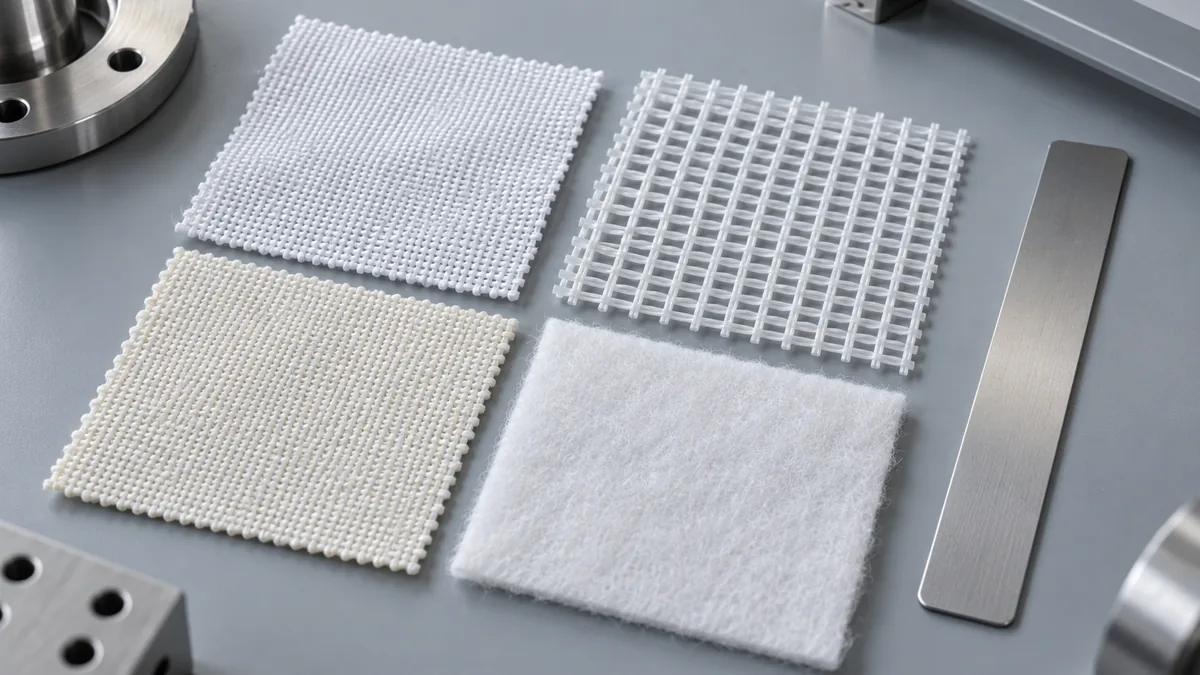
Neutralization is the single change that most often moves the answer from PP to PET, and it is worth checking what the neutralization actually achieves. Dosing control that holds the feed at pH 6 to 8 most of the time can still pass pockets of stronger acid, and chloride remains in solution regardless of pH. Take the pH and chloride readings at the press feed, over a full batch, before the cloth family is fixed.
Monofilament, Multifilament or Non-Woven Constructions
Construction changes where the solids are captured. A monofilament weave presents a uniform aperture, so particles build a cake on the surface, the cake lifts cleanly, and the cloth recovers most of its permeability after washing. Multifilament yarns are bundles of fine filaments, and the spaces between them capture fines inside the yarn. That gives clearer filtrate early in the cycle, and it also stores the iron hydroxide gel that later resists washing. Non-woven media capture solids through the full thickness, so they hold more dirt before permeability collapses and deliver good clarity, at the cost of a cleaning routine that has to work every time.
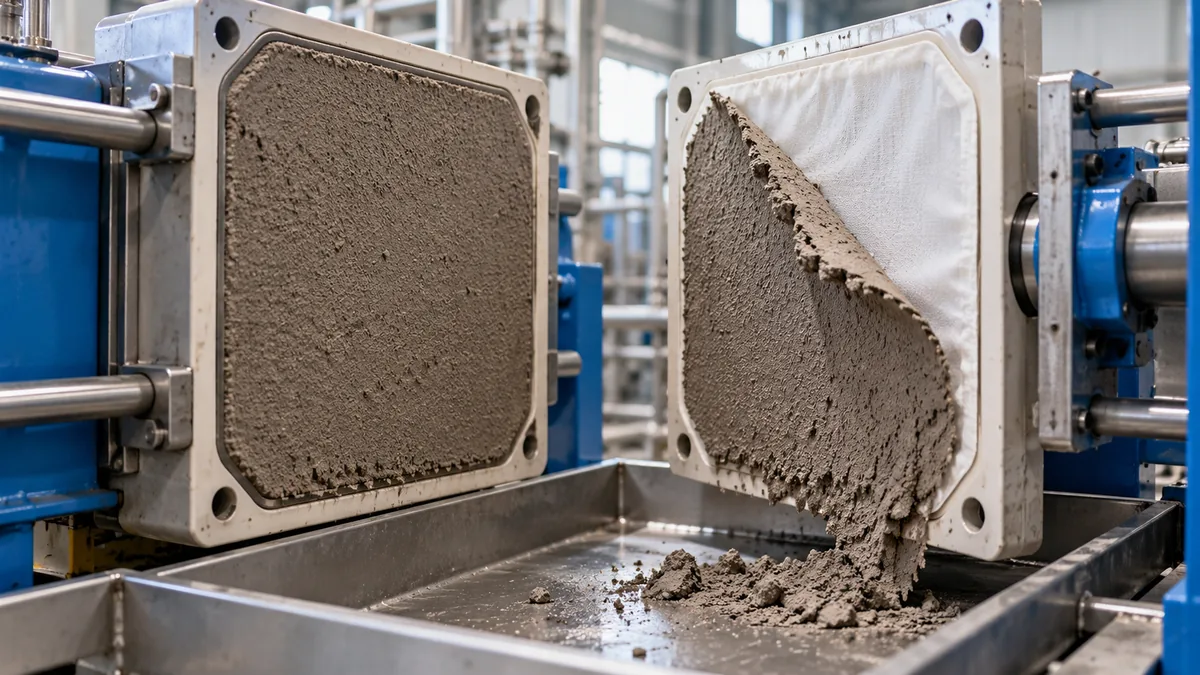
Aperture is the second decision and it is a trade rather than a setting. A tighter weave improves initial clarity and raises the resistance the pump has to overcome, which lengthens the cycle and brings blinding forward on a gel-like sludge. An open weave fills quickly and may pass fines during the first minutes of each cycle. Choose from the measured particle size distribution rather than the mean particle size, because the fines below the mean are usually what block the medium.
Confirm the mechanical details at the same time. Feed hole layout and plate size decide whether the cloth fits at all, the gasketed or non-gasketed arrangement decides how it seals at the feed port, and the seam, edge treatment and heat-set finish decide how the cloth behaves under repeated clamping. The plant’s actual washing method belongs in the same conversation, since a cloth chosen for surface release loses that advantage under a cleaning procedure that drives solids back into the yarn.
Filter Plate Material Selection for Acid-Bearing Sludge
The plate stack is where chemistry and pressure meet. PP plates are listed from pH 1 to 13 at up to 85 °C, in pressure classes of 0.8, 1.0 and 1.6 MPa and sizes from 500 to 1500 mm, which makes them the usual match for a pH 1 to 3 sludge on a standard press. HDPE plates widen the pH range to 1 to 14 and bring a dense, low-adhesion surface that suits sticky, abrasive residue, but the continuous limit of 60 °C and the 0.6 to 1.0 MPa pressure classes rule them out on warm or high-pressure duty.
Rubber membrane plates change what the press can do rather than what it can resist. Their listed range of pH 2 to 12 and 75 °C is narrower than PP, and at a filtrate pH of 1 to 2 the membrane sits outside its listed envelope. If cake moisture is the real problem and the filtrate is that acidic, the sequence to review is neutralization performance first, membrane specification second, and longer filtration time as the fallback that costs cycle time instead of consumable life.
Pressure class deserves its own check. It describes the plate within the press, not the feed pump, so confirming it means confirming the hydraulic clamping force and the chamber depth the stack was designed around. A plate quoted at the right pressure but the wrong port layout still will not load.
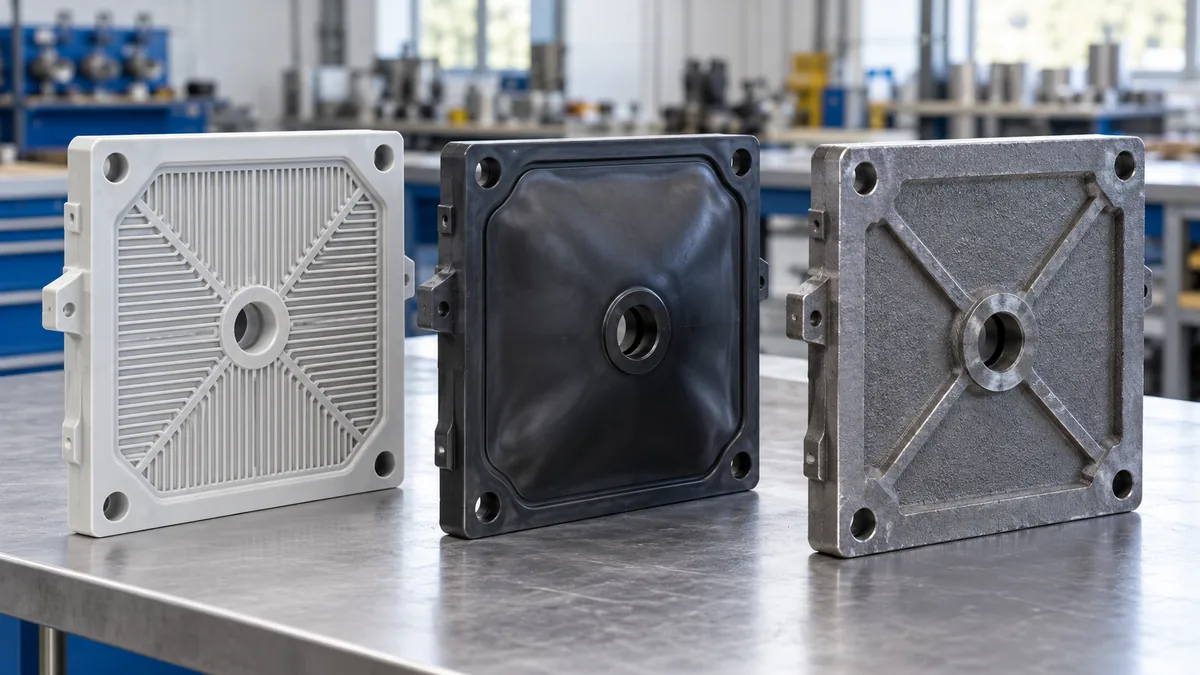
Plate condition belongs in the same review as the cloth. A sealing face that has been scratched or corroded will leak no matter which cloth is fitted, and worn faces accelerate cloth damage at the edges. Flatness checks and a look at the feed port and sealing ring area cost an hour at shutdown and explain a surprising number of repeat cloth failures.
Where Cake Moisture and Cycle Time Are Lost
Three separate problems produce the same complaint, and they are worth separating before any part is ordered. A blinded cloth loses permeability uniformly across the chamber, so every chamber fills slowly and filtrate stays clear. Blocked drainage shows up unevenly, with some chambers wetter than others because the grooves or filtrate outlets are carrying less liquid away. Insufficient squeeze leaves a cake that drains normally and still holds water, which is what membrane plates exist to fix.
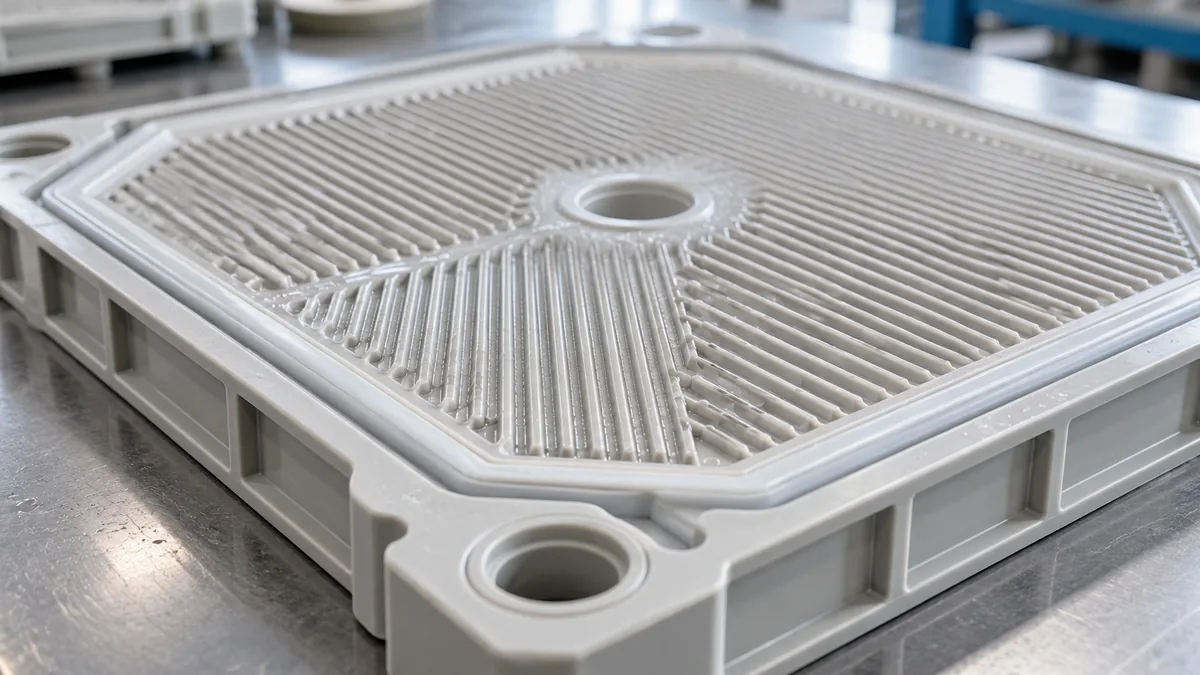
Drainage blockage is common on iron-bearing sludge because fine hydroxide solids migrate into the plate grooves and pack there. The useful check is a physical one at shutdown, plate by plate, looking at groove depth and outlet clearance rather than relying on the pressure gauge. Record what is found, because a groove that blocks twice in a season points to a different cloth aperture or a different washing routine, not to a plate defect.
Blinding is best tracked with numbers the plant already has. Log the fill time per chamber, the filtrate rate, cake moisture by chamber and the position of any torn cloth. A cloth that has gained weight and lost air permeability after cleaning is telling you the capture mechanism is wrong for the solids; a cloth that is clean and still slow points to the plate side or the feed.
What to Put in the RFQ and How to Accept the Delivery
Most pickling sludge enquiries fail at the first line, because the slurry description is too thin for a supplier to screen materials and too thin to compare two offers. The fields below are the ones that change the answer rather than decorate the file.
| RFQ field | What to send | Why it changes the answer |
|---|---|---|
| Liquor chemistry | pH at the press feed, chloride level, acid type | Sets the polymer family and removes cast iron from consideration |
| Temperature | Continuous and peak feed temperature | PP at 85 °C and PET at 120 °C lead to different cloth and plate choices |
| Solids | Particle size distribution, solids loading, share of fine hydroxide | Sets the aperture and predicts blinding risk |
| Duty | Target cake moisture, cycle time, batches per day | Decides whether squeeze is needed or a tighter weave is enough |
| Press details | Plate size, chamber depth, feed port layout, pressure class, gasketed arrangement | Determines whether the cloth fits and the plate loads |
| Documentation | Lot marking, cloth weight, model, material certificate | Makes a repeat order and a complaint comparable |
Two RFQ lines show the difference in practice. A line that reads “PP filter cloth, 25 micron, for filter press” gives a supplier nothing to fit and nothing to compare, and it will be answered with a catalogue page. A line that reads “PP multifilament, twill, heat-set, 25 μm on the stated test basis, for a 1250 mm plate with centre feed and gasketed edge, matched to the measured liquor pH and feed temperature, 60 pieces, lot-marked with cloth weight on the label” can be quoted, checked against the press on arrival and repeated next year without renegotiation.
Acceptance is a separate step from ordering. On receipt, check the count, the measured dimensions against the approved drawing or the removed cloth, the feed hole positions, the cloth weight, and the lot marking. On the plates, check edges and corners for shipping damage and confirm the port layout against the stack before installation. Then run a defined trial rather than an open-ended one: same feed, a set number of cycles, with fill time, filtrate clarity, cake moisture and cloth condition recorded and compared against the consumable being replaced.
Send the Slurry Data Before You Order
Send the liquor pH and chloride figure, the continuous and peak feed temperature, the particle size distribution, the target cake moisture and cycle time, the plate size and chamber depth, the pressure class, and the construction you are running today. That set lets a supplier screen cloth and plate candidates against their listed envelopes and say plainly where a data sheet settles the question and where only a trial will. It also leaves both sides the same record to compare a replacement against. The Shine Technology technical team reviews these sheets through the contact form at shinefiltration.com.
FAQ
Can polyester filter cloth handle pickling sludge?
Only when the liquor reaching the press sits inside its listed pH 4 to 9 band. Raw pickling sludge commonly runs at pH 1 to 3, which is outside that range, so polyester is not the first choice for untreated feed. The case for it appears when the plant neutralizes ahead of filtration and the feed runs above the 85 °C PP ceiling, where its 120 °C limit earns its place. Confirm the pH at the press feed over a full batch, because neutralization control that averages correctly can still pass acidic pockets.
Why does a new PP cloth blind faster than the last one?
Compare three things before blaming the cloth. Check whether the aperture moved tighter than the previous order, whether the solids loading or neutralization changed, and whether the plate grooves are carrying liquid away. A cloth that gained weight and lost air permeability after cleaning is trapping fines inside the structure, which points to construction rather than chemistry. A cloth that is clean and still slow usually points to the drainage side or to a higher feed solids load.
Do we need membrane plates for this sludge?
It depends on the moisture target and on the filtrate pH. Rubber membrane plates are listed from pH 2 to 12 at up to 75 °C, with a squeeze range of 0.8 to 1.5 MPa, so a filtrate at pH 1 to 2 sits outside that envelope. Where the moisture target is strict, review neutralization performance first, then the membrane specification, and treat a longer filtration cycle as the fallback that costs time rather than consumable life.
When should the cloth be replaced instead of cleaned?
There is no calendar answer. Track fill time per chamber, filtrate rate, cake moisture and cloth weight after cleaning, and inspect the feed port and edges at every change. Replace when cleaning no longer restores permeability to the level recorded after the previous wash, or when local damage appears at the feed port or sealing edge. A cloth that is still uniform and recovers after washing is doing its job even if it looks discoloured.