Filter Cloth Blinding: Embedded Fines or Surface Deposits?
Filter cloth blinding is a loss of permeability that cake discharge and routine washing no longer restore, and it has two distinct causes. Solids can collect on the cloth face as a surface deposit, or they can lodge inside the pore structure as embedded fines. A surface deposit responds to cleaning, discharge adjustment and sometimes chemical control. Embedded fines usually mean the construction or the operating pressure is wrong for the solids, and no wash will return the cloth to its original flow. Both conditions appear as longer cycles, wetter cake and cloudier filtrate, so the cloth often gets replaced before anyone establishes which one is present, and the replacement blinds the same way.
Why Two Different Problems Produce the Same Blinding Symptom
The distinction is where the resistance sits. In surface deposition the resistance is a layer on the upstream face, and the cloth behind that layer may still be close to its original permeability. In pore plugging the resistance is inside the cloth itself, so the face can look almost clean while flow is lost.
Three conditions get called blinding, and only two are deposits. The third is a change in the cloth material: compaction of a needle-punched felt under repeated pressure, thermal shrinkage, or chemical attack that hardens or weakens the fiber. That version also resists washing, but it is not a fouling problem, and no cleaning program will recover it. Separating the three takes roughly one shift of bench work and prevents a replacement order placed against the wrong cause.
| What you compare | Surface deposit | Embedded fines |
|---|---|---|
| Where the resistance sits | A layer on the upstream face; the cloth behind it may be near original permeability | Inside the yarn bundle or the felt body; the face can look almost clean |
| Dry mass against an unused piece | Gain roughly follows the amount of deposit | Small gain with a larger loss of flow |
| Water rinse on a sample | Flow improves measurably | Little or no improvement |
| Chemical wash on a sample | Improves when the deposit is scale, oil or polymer | Partial recovery at best, and less after each cycle |
| Pattern across the press | Every chamber on the same feed, or the zones where flow was lowest | Often worst near feed ports, edges and the lower part of the plate |
| Appearance after discharge | Film, crust or discoloration that can be scraped | Uniform darkening or stiffening with no distinct layer |
The pattern across the stack is often the quickest first filter. A cause in the feed, the pH or the flocculant dose shows up on every chamber at roughly the same time. A cause in one plate, one outlet or one cloth fit stays local.
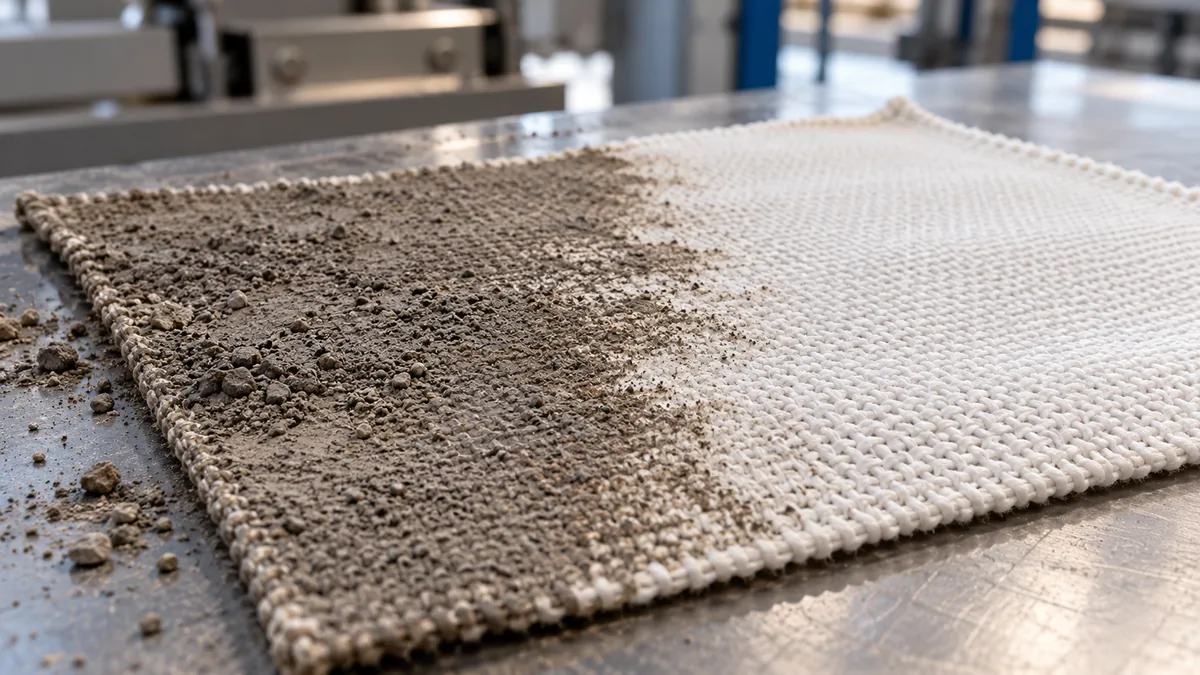
Where Embedded Fines Lodge Inside a Filter Cloth
A cloth pore is not a straight hole. In a woven fabric the opening is formed where warp and weft yarns cross, and the path through it narrows and turns. Whether a particle stops at the surface or travels inside depends more on yarn construction than on the nominal micron rating printed on the data sheet.
In a multifilament woven cloth, each yarn is a bundle of fine filaments, and the spaces between those filaments form internal channels narrower than the surface opening. Fines that pass the surface aperture can enter a channel and stop where it closes. Pressure drives them in, releasing the press does not pull them out, and the relaxation of the fabric can close the channel further around the particle. Typical ranges run from about 5 to 45 µm for polyester models such as 729, 750A, 750B and 850, and 8 to 50 µm for polypropylene constructions such as 750AB-PP, PP-1080 and PP-729. The rating describes retention at the surface; it says nothing about how much internal volume the yarn offers.
A monofilament cloth is built from single filaments, so there are no internal yarn channels to fill. The pore is a defined gap between round filament surfaces, and a particle either stays on the surface or passes. That property is why monofilament media can be washed and reused: the particle sits where liquid and mechanical action can reach it. Available monofilament ranges cover polyester at 10 to 100 µm and polypropylene at 10 to 120 µm.
Needle-punched nonwovens are designed for the opposite behavior. The three-dimensional fiber structure captures particles through the thickness of the medium, which gives high dirt holding and clear filtrate from the start of a cycle. The same structure stores what it captures. Once the interior volume fills, or once the web mats under repeated compression, permeability falls and back-flow has no open path to carry solids out. Areal weights in the 550 to 700 g/m² range are usual for sludge and tailings duty, and a higher weight means more internal volume, not more resistance to plugging.
The choice between surface capture and depth capture is a choice of failure mode, not a ranking. A surface-capture cloth blinds slowly and cleans easily, but it holds less dirt and may pass fines early in a cycle. A depth-capture cloth gives clarity and capacity but keeps what it takes. Neither is better in general; one is easier to live with in a given plant.

Reading the Cloth After Cake Discharge
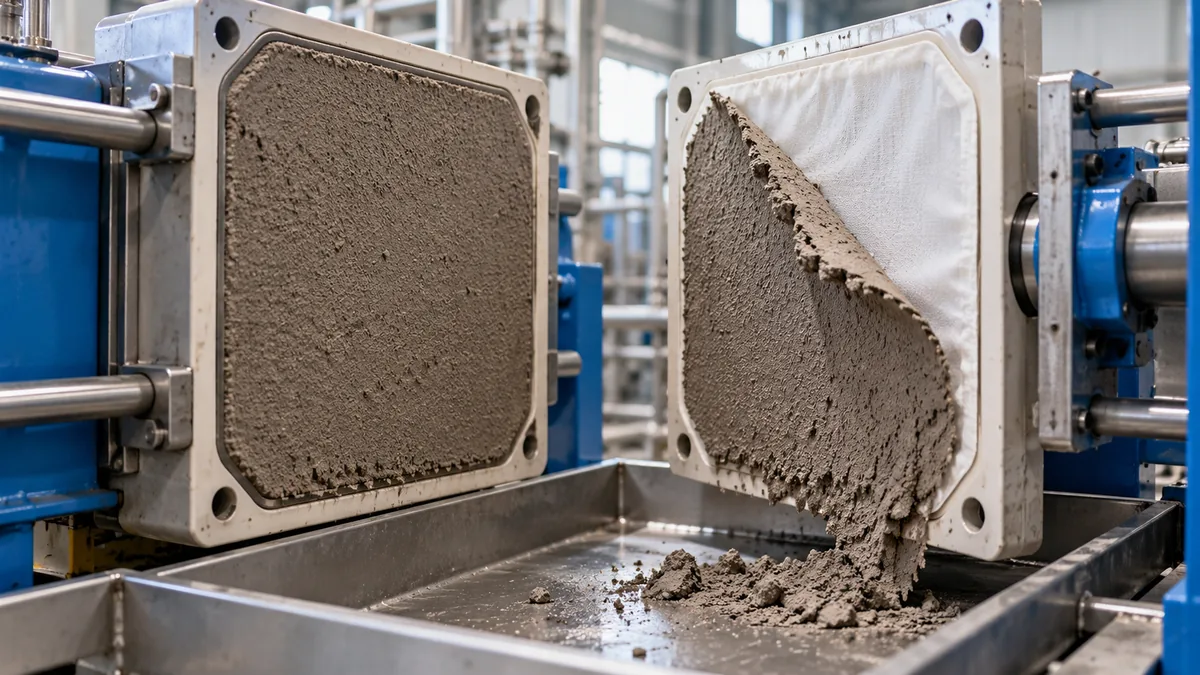
Take one affected chamber out of service and remove the cloth before washing it, because washing destroys the evidence. Photograph the cloth wet, then air-dry it, or dry it below the continuous limit of the fiber (up to 120°C for polyester, up to 85°C for polypropylene), and photograph it again.
- An even film that peels or scrapes off points to a surface deposit, most often cake residue or scale.
- A crust in a ring around the feed port comes from deposition at the entry jet and can belong to either mechanism, but it is localized.
- A pattern that copies the drainage grooves or the plate surface points to a drainage or fit problem rather than uniform blinding.
- A uniformly darkened cloth with no distinct layer points to fines inside the structure.
- A stiff, board-like cloth that cracks when folded points to compaction or chemical attack, not fouling.
- Deposit on the plate side of the cloth means solids are passing through the cloth and collecting behind it, which indicates a hole, a rating mismatch or edge bypass rather than blinding.
A dry sample held against a light source shows thin areas, pinholes and changes in opacity. Compare it directly with an unused piece of the same model from the same roll. The comparison is relative and gives no number, but it separates a cloth carrying a surface layer from one whose body has changed.
Feel matters as well. Rub the dry surface: a gritty residue that survives running water suggests mineral scale, while a slick or soapy feel suggests oil or polymer film. A cloth that feels heavier and denser than the unused piece, with no visible layer, is a candidate for embedded fines.
Bench Checks That Separate Surface Deposit from Embedded Fines
These seven checks use a sample, a scale, clean water and the cleaning chemicals already on site. Run them in order and stop once the answer is clear.
-
Cut matched samples. Take two pieces of about 100 × 100 mm from the blinded area, note the position (feed port zone, center, edge, lower part of the plate), and take one piece from an unused cloth of the same model and, where possible, the same roll. Position matters because the failure pattern is itself evidence.
-
Weigh the dry samples. Air-dry the used and unused pieces and weigh them. A large mass gain for the same area is consistent with a retained deposit. A small gain with a large flow loss points to internal plugging. The comparison holds only between the same model, weight and thickness; a different construction makes it meaningless.
-
Run a water rinse test. Rinse one sample under low-pressure clean water at room temperature, dry it and weigh it again. Then pass a set volume of water through a fixed area at a fixed head and record the time. If flow returns close to the unused piece, the resistance was a removable surface layer.
-
Run a back-flow test. Pass clean water through the sample from the filtrate side. If forward flow recovers, the blockage sits at or near the surface. If it does not, the pore channel is plugged or the fiber structure has changed.
-
Run a chemical sequence test. Use separate samples for warm water with a neutral detergent, a dilute acid wash and a dilute alkali wash, staying inside the fiber’s pH and temperature envelope. Record which one recovers flow. The agent that works identifies the deposit class: acid for carbonate and some silicate scale, detergent or solvent for oil and polymer film. If none recovers flow, the loss is structural.
-
Inspect a cross-section. Cut across the sample and look at the yarn bundle or the felt interior under low-power magnification. Fines visible inside the yarn or the web confirm embedding rather than a surface layer.
-
Measure permeability in consistent units. If an air permeability instrument is available, test the cleaned sample and an unused piece of the same model, thickness and area, using one method and one unit. Published figures for different constructions are often quoted in different units, for example mm/s for one needle felt and m³/(m²·min) for another, so convert before drawing a comparison.
Keep the acid and alkali tests on a bench, with the same protective equipment used for the process chemicals, and treat the used samples as process residue.
When the Cloth Is Not the Cause of the Blinding
Before accepting a cloth diagnosis, rule out the components around it. A meaningful share of blinding reports turn out to be drainage, fit or sealing problems, and each of those reproduces itself on the replacement cloth.
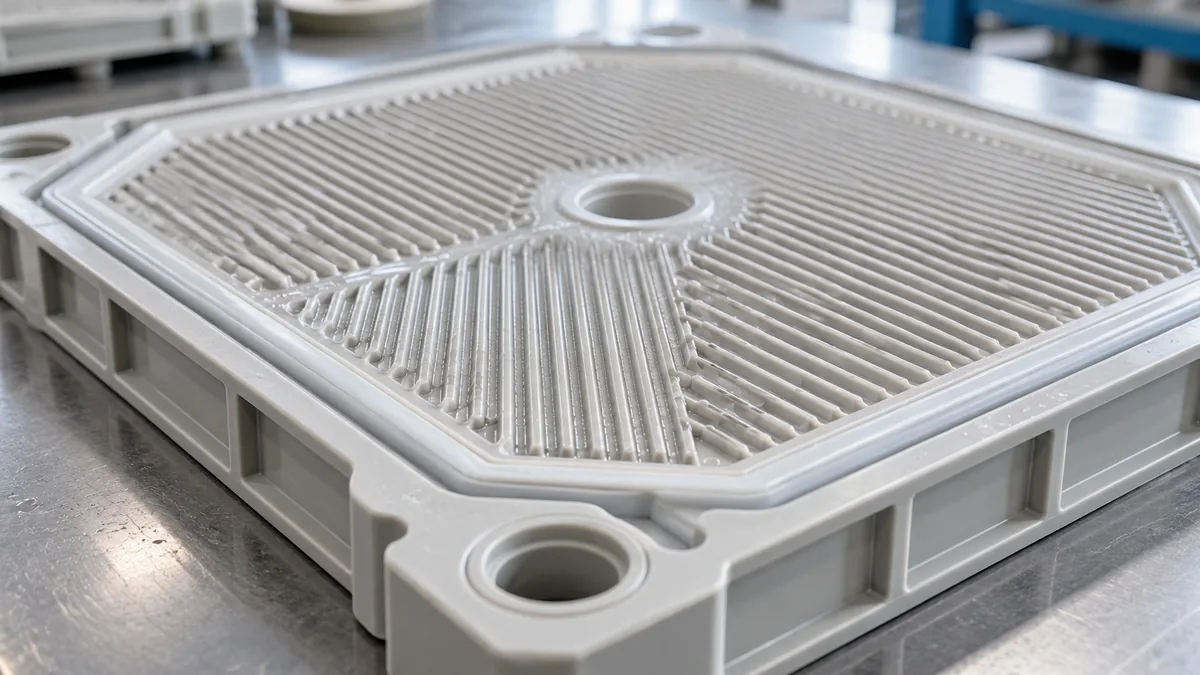
Filtrate leaves through the plate grooves and the outlet. If a groove is blocked with dried solids, scale or loose fibers, the chamber cannot drain, the cake stays soft and the cloth stays wet between cycles. Flow is slow and cake moisture is high, which looks like blinding while the cloth may be sound. Check the grooves and the outlet screen at the next shutdown, and check whether a cloth has been fitted over a drainage port.
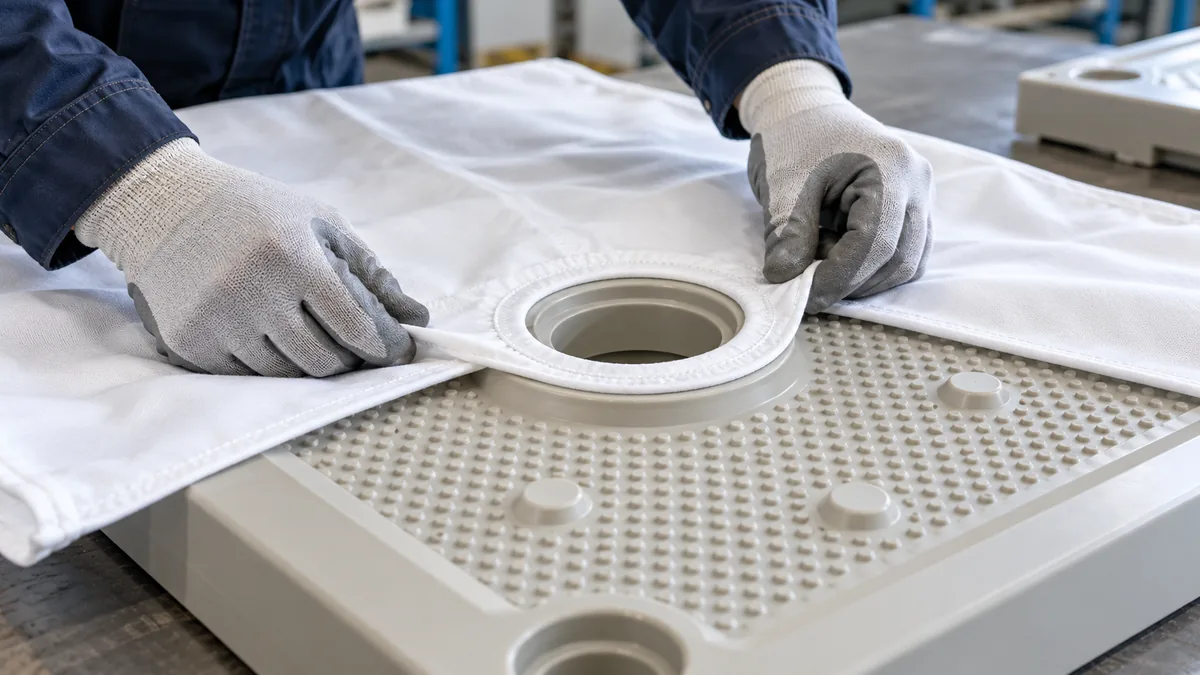
A wrinkle, a fold or a loose cloth creates zones where slurry bypasses the cake and where cake cannot release. Folds also concentrate loading and wear along a line, which is why damage repeats in the same place. Check fit after installation and again after the first few cycles, once the cloth has taken its set.
A leak at a sealing face lets slurry escape and dry on the cloth edge. The crust that forms looks like localized blinding but is a sealing fault, and replacing cloth will not remove it while the leak remains.
Changes on the feed side often explain a sudden onset. A finer grind, higher solids, higher viscosity, an increase in flocculant dose or a switch of flocculant type, a pH shift that changes particle charge, or oil ingress can all produce a film or a stickier cake. Flocculant overdose is an easily tested suspect: if the deposit feels slick and dissolves in warm detergent but not in acid, review the dose before ordering cloth.
Filling the chamber fast and applying full pressure immediately drives fines into the cloth before a permeable cake layer has formed. A staged ramp lets a cake establish that then filters the fines. That is a mechanism rather than a fixed recipe, and the right ramp has to be found on the press itself.
Matching the Response to What the Checks Show
The checks point to an action. Use the table as a decision path, then verify the change with the same test that identified the problem.
| Evidence from the checks | Most likely mechanism | First action | What confirms it | Cloth change needed |
|---|---|---|---|---|
| Flow returns after a water rinse, dry mass clearly higher | Surface cake residue that is not releasing | Review discharge, cloth tension and cycle end point | Cycle time returns to baseline and stays there | Not yet |
| Flow returns after dilute acid only | Carbonate or silicate scale | Check feed hardness and pH, add a wash step | No scale visible between washes | Not yet |
| Flow returns after detergent or solvent only | Oil, polymer or flocculant film | Check flocculant dose and type, oil ingress, cleaning agent | Clean face after the next campaign | Not yet |
| No recovery after any wash, fines visible inside yarn or web | Embedded fines | Reduce peak pressure and ramp rate, review rating against the particle distribution, consider surface capture | A proposed construction recovers in the same bench test | Yes |
| No recovery, cloth stiff, cracked or glazed | Compaction or chemical attack | Check peak temperature and pH against the material envelope | A sample from a fresh roll behaves normally | Yes, once the operating condition is corrected |
| One or two chambers only | Drainage, fit or sealing fault | Inspect grooves, outlet, fit and sealing face on those plates | Affected chambers match the rest after correction | No |
The listed envelopes are the first check on row five: polyester to 120°C and pH 4 to 9, polypropylene to 85°C and pH 1 to 13, and nylon to 100°C and pH 5 to 11. A peak above the listed limit, even for a few cycles, can change the fiber permanently.
If the answer is a construction change, the decision is between surface capture and depth capture, and the rating has to follow the measured particle size distribution rather than the data sheet of the cloth currently installed. We manufacture both routes in the common polymers, so the practical comparison is a trial on one chamber with agreed criteria, not a catalogue argument.
When the cleaned sample still shows a large permeability deficit against an unused piece and the cloth has visibly stiffened or thinned, the cloth has reached the end of its function. Replace it, but correct the mechanism first, or the replacement will follow the same path.
Records That Make the Next Diagnosis Faster
The diagnosis is quicker when each cloth set carries its own history. Keep the following together:
- Model, material and lot, so a repeat order can be matched to the cloth that was tested.
- Installation date and cycles completed, because cycle count measures exposure better than calendar time.
- Feed data: solids concentration, particle size (D50 and top size), pH and temperature range including peaks.
- Operating data: typical and peak feed pressure, ramp, cycle time trend, filtrate clarity at the start and end of the campaign, cake moisture.
- Cleaning data: method, chemical, concentration, temperature, frequency, and whether flow recovered after each wash.
- Chamber positions affected, since a local pattern points to plates or fit and a general pattern points to feed or cloth.
- Photographs: wet after discharge, dry, backlit, and one cut section.
- A retained unused piece from the same roll, which is the reference for every comparison above.
One page per cloth set is enough. When a supplier asks for a sample, that page turns a general question into a specific one.
Send the Cloth Sample and the Cycle Record
Cut a dry sample of about 100 × 100 mm from the blinded area, add an unused piece of the same model and the position in the stack, and send them with the record above. The Shine Technology technical team will compare structure and permeability, state which mechanism the evidence supports, and set out what should change before the next order: cleaning practice, operating conditions, or cloth construction. A sample review separates a deposit from embedded fines; it does not by itself approve a construction change for your process, which still needs a trial on your own slurry. Send the details through shinefiltration.com and note the affected chamber positions.
FAQ
Can a blinded filter cloth be restored by washing, or does it need replacing?
It depends on which mechanism the checks show. If a water rinse, an acid wash or a detergent wash brings flow on a sample back close to an unused piece of the same model, the cloth is still doing its job and the correction belongs in cleaning, discharge or feed control. If each wash recovers less than the one before and fines are visible inside the yarn or the web, the cloth has lost capacity that washing cannot return. Test on a sample before treating a full set, because a wash outside the fiber’s pH or temperature envelope can damage the cloth it was meant to restore.
How can I compare cloth condition without an air permeability tester?
Use a timed-flow test. Fix a sample of known area in a simple holder, hold the water head constant, and record the time needed to pass a set volume. Repeat on an unused piece of the same model, weight and thickness, and compare the times instead of judging by feel. The result is relative rather than a specification, but it shows whether cleaning recovered the cloth. Comparisons between different constructions are not meaningful, because thickness and pore structure shift the baseline.
Why does blinding appear on only one or two chambers?
Localized blinding usually has a local cause. Check the drainage grooves and filtrate outlet on those plates, the cloth fit and tension, the sealing face, and whether a cloth covers a drainage port. A chamber that receives more feed because of port layout or a partly closed valve also loads faster. Causes in the feed, the pH or the flocculant dose affect every chamber, although they often appear first where flow velocity is highest, such as the feed port zone.
Does a tighter micron rating reduce blinding?
Often the opposite. A tighter surface rating can improve clarity by retaining a finer cake, but when the openings sit close to the size of the fines, particles lodge in the openings instead of forming a cake that discharges cleanly. The rating also interacts with construction, since a depth-capture medium holds more regardless of the nominal figure. Set the rating from the particle size distribution and the clarity target, then confirm it in a trial on one chamber rather than defaulting to tighter.
Should we switch to monofilament cloth to stop blinding?
Only if the checks point to embedded fines and the process can tolerate less depth capture. A monofilament cloth has a defined pore between single filaments, so particles are easier to remove and flow recovers better after washing. The trade is lower dirt holding, which can appear as cloudier filtrate early in a cycle or a need to adjust the rating. Agree the acceptance criteria first, then trial one chamber against them: clarity, cycle time, cake release and wash recovery.