Abrasive Slurry
Hard abrasive particles continuously scour the cloth surface.
Filter cloth abrasion is a mechanical failure marked by thinning, pinholes, cuts or tears—often around feed ports, plate edges and sealing zones. Locate the wear pattern before replacing the cloth, because hard particles, plate burrs, wrinkles and chemical or heat damage require different corrective actions.
A short service life is not solved by a finer aperture alone. Map where each cloth fails, inspect plate contact surfaces and compare the slurry's abrasiveness, pH and temperature with the selected fiber before choosing a tougher construction.
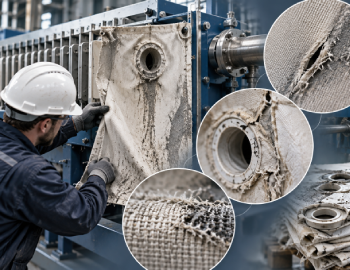
Hard abrasive particles continuously scour the cloth surface.
Burrs, cracks or sharp edges on worn plates cut the cloth.
Misaligned cloth creates concentrated friction during clamping.
Hot acid or alkali slurry reduces fiber tensile strength.
Select thickened monofilament or double-layer wear-resistant cloth for abrasive slurry.
Polish burrs before installation and replace deeply scratched plates.
Center and tension each cloth without wrinkles, protect feed and sealing areas from sharp contact, and verify that fiber chemistry matches slurry pH and temperature. Track failure location and operating hours so recurring mechanical damage can be separated from chemical degradation.
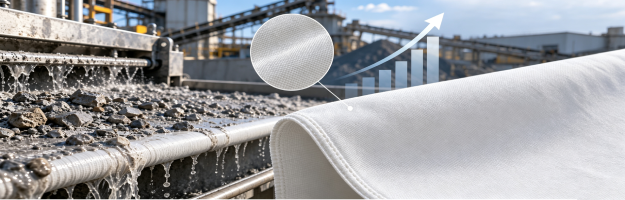
High elasticity and superior abrasion resistance for slurry containing hard particles.
View Product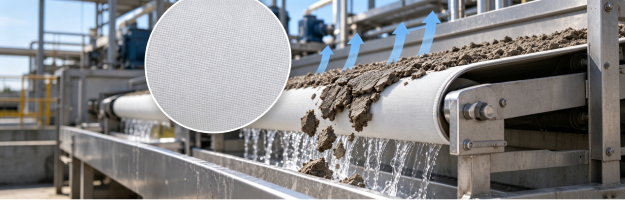
Uniform two-dimensional mesh with high flow, easy cake release and reusable construction.
View ProductShare your equipment model, medium, temperature and operating pressure. Our engineers will recommend a practical solution within 24 hours.