Choose a filter cloth material that can tolerate both the slurry and the cleaning process. Then select the yarn, weave and finish based on the filtrate clarity, cycle time and cake release you need. Before ordering, confirm that the finished cloth fits the plate and compare it with your current cloth under the same operating conditions. ANDRITZ filter cloth selection reference
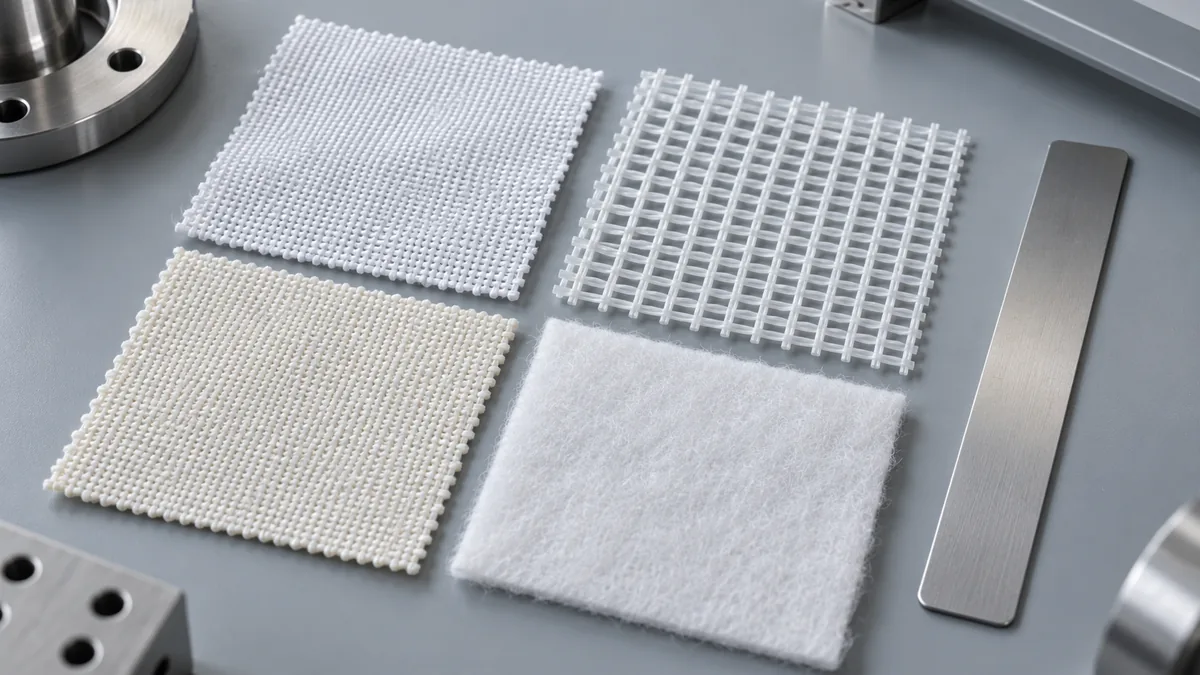
How to Select a Filter Cloth Material
Start with slurry chemistry and operating temperature
List the chemicals and their concentrations, the slurry pH, and the normal and peak temperatures. Include the cleaning agents and wash temperature. A cloth may handle the slurry during filtration and still deteriorate during repeated cleaning.
- Polypropylene (PP) is a starting point for many aqueous acidic and alkaline slurries, including pickling residue, inorganic salt suspensions and wastewater sludge. SHINE lists a continuous working temperature of up to 85°C for the woven grades on its product page. Confirm compatibility with the actual chemicals and cleaning agents. Polypropylene filter cloth
- Polyester (PET) is a candidate for warmer duties where dimensional stability matters, such as sludge, kaolin and pigment filtration. SHINE lists up to 120°C continuous service for the heat-set polyester grades described on its product page. Check compatibility with the wash solution, especially for hot alkaline cleaning. Polyester filter press cloth
- Nylon (PA) is a candidate when hard particles cause cloth wear, such as in quartz sand and abrasive mineral slurry. SHINE lists up to 100°C continuous service for the grades on its product page and identifies concentrated strong acids as a limitation. If tears repeatedly appear around the feed hole or plate edge, inspect those contact points before specifying a tougher cloth. Nylon PA filter cloth
These temperatures refer to the listed fabric grades. Confirm the working limit of the finished cloth, including its seams and feed neck, under the actual combination of temperature and chemical exposure.
Match the fabric construction to the filtration problem
Monofilament yarn has a smooth surface. It is worth trialling when a granular or crystalline cake sticks to the cloth, or when frequent washing slows production. Check initial filtrate clarity alongside cake release.
Multifilament yarn combines several fine strands. Consider it when solids retention is a priority. The weave and finish also affect how readily the cloth drains and releases the cake, so compare finished fabric grades even when their fiber and yarn type are the same. Micronics filter cloth terminology
Nonwoven felt is another candidate for fine solids capture. For sludge or fine slurry, assess how quickly the media loads, whether the cake releases cleanly and how much flow returns after washing.
Compare aperture, retention and air permeability separately
When a specification gives a value in microns, ask what it describes. A measured opening in a woven cloth and a particle retention result from a filtration test answer different questions. If filtrate clarity is the acceptance criterion, agree on how and when it will be measured. The first filtrate through a clean cloth can differ from the filtrate after a cake has formed.
Air permeability measures airflow through the fabric under specified test conditions. To compare supplier values, ask for the unit, test method and pressure differential. Use a slurry trial to verify liquid throughput and clarity under your operating conditions. ASTM D737 textile air permeability test
Confirm plate fit and run a comparison trial
Match the finished cloth to a plate drawing or an existing sample. Check the feed hole position and diameter, the neck dimensions, the sealing edge and the attachment points. For a gasketed plate, include the gasket groove details. For a two-sided cloth, confirm the construction on both faces and the connection through the feed opening. Filter cloth replacement guide
Trial the candidate cloth against your current grade using comparable slurry, feed pressure and cycle settings. Record early and steady filtrate clarity, filtration time, cake moisture, discharge behavior and cleaning effort across repeated cycles. For example, if a candidate gives clearer filtrate but takes longer to fill the press, compare the extra cycle time with the clarity improvement your process requires.
What to Send for a Filter Cloth Quote
A drawing or sample helps establish fit. Operating data helps identify a fabric that will perform in your press. Include the following information when requesting a quotation.
- Equipment and fit. Provide the press make and model, plate type, plate dimensions, finished cloth drawing and feed hole details.
- Slurry and operating conditions. Describe the liquid and solids, particle size distribution if available, solids concentration, pH, working temperature and feed pressure.
- Cleaning conditions. Specify the cleaning agents, concentrations, wash temperature and frequency.
- Current cloth. Share the existing material, grade or part number, yarn type, thickness and any available aperture or air permeability data. Include the test conditions if known.
- Performance and quantity. State what you want to improve, the required quantity, and whether you need samples before placing a production order. Include any documentation required for food contact or other special duties.
For an equivalent replacement, send the existing cloth code and drawing. To resolve a recurring problem, include photos of the failed cloth and explain where the wear, blockage or sticking occurs. SHINE can use those details to discuss suitable grades and prepare a quote for the required construction. Request a filter cloth quote